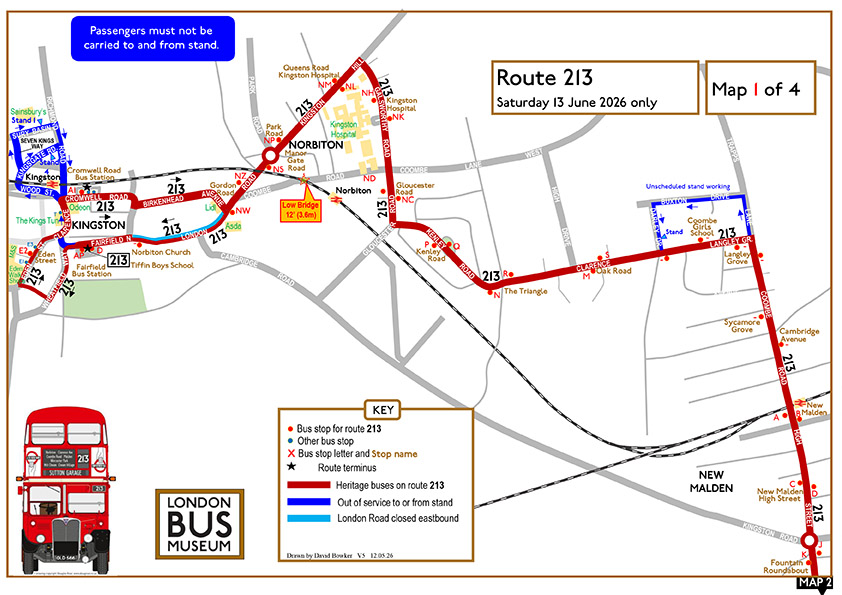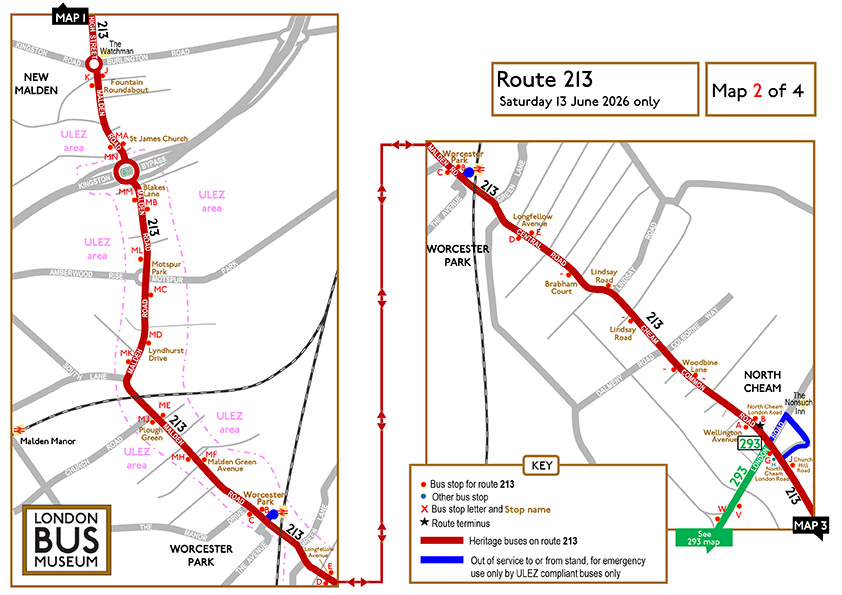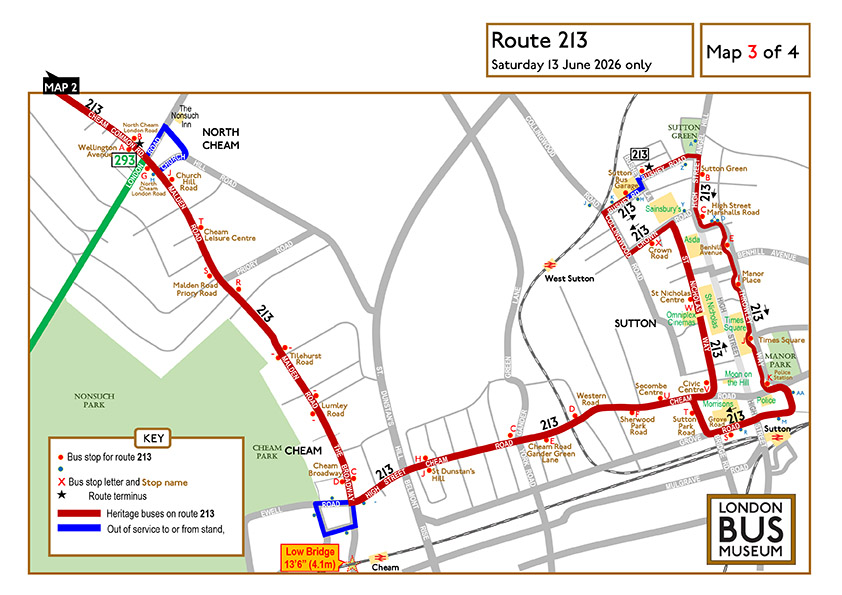
Ride free on old buses in service on London bus route 213 between Kingston and Sutton ~ 13th June 2026!
Bus route 213 has been running between Kingston and Sutton since 1921 – that’s 105 years – serving Norbiton Station, Coombe Lane, Traps Lane, New Malden, Worcester Park, North Cheam and Cheam .
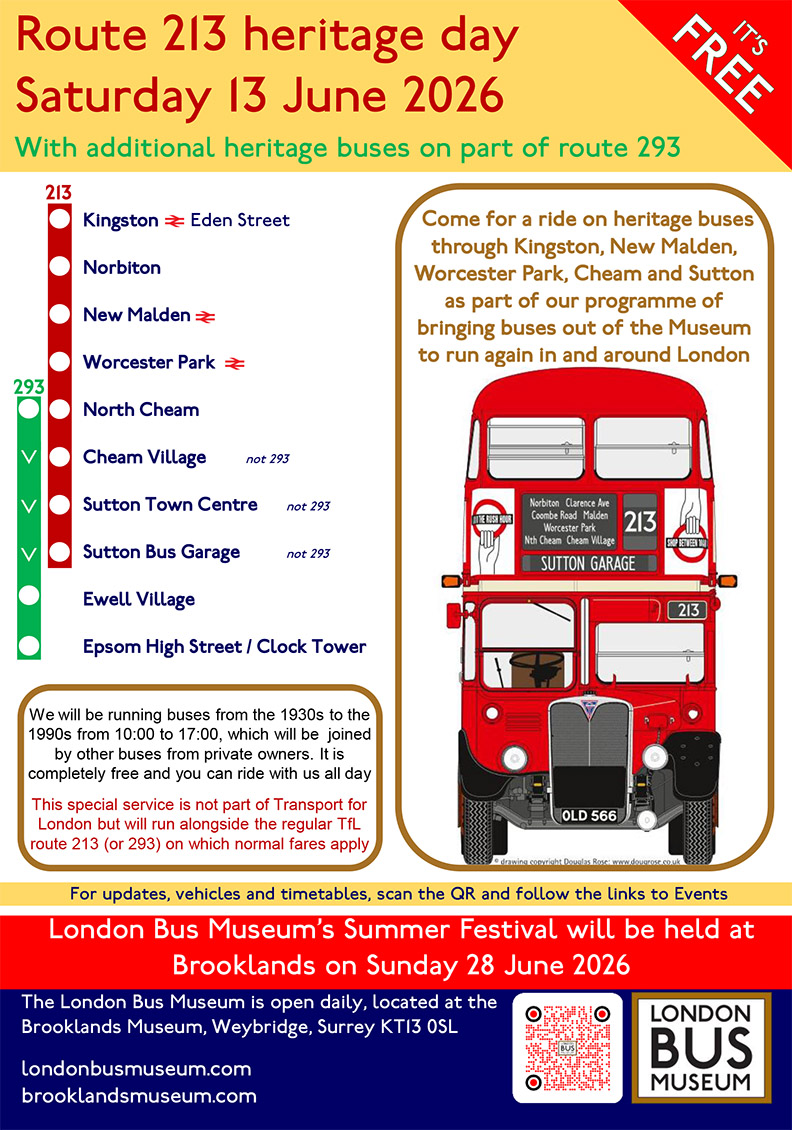
On Saturday 13th June 2026 between 1000 and 1700, the London Bus Museum will be running free heritage buses dating from the 1950s to 1970s alongside the normal daily service on route 213.
Open-platform buses with real conductors will run between Kingston and Sutton Garage. Buses serve all route 213 bus stops - no need to book, just turn up at a route 213 bus stop and put out your hand!
Buses being used will mostly be the iconic Routemaster, dating from the late 1950s and 1960s, and their predecessor the RT-type, which in the 1950s formed the largest standardised bus fleet in the world, together with some special buses. Some buses are from the Museum’s collection, others provided by other owners. And it’s all free!
Please note that all these buses pre-date the low-floor, easy access buses that we take for granted today and there are steps at the entrance and inside.
Most modern buggies cannot be carried as they are too large to fit under the stairs; nor can wheelchairs be accommodated. However conductors will make every effort to help the less able and those with small children enjoy a ride back in time.
Well-behaved dogs are welcome but are carried at the conductor's discretion, and must be on a lead and not occupy seats.
![London Transport RT4779 Piccadilly Circus [Mark Lyons]](https://www.londonbusmuseum.com/wp-content/uploads/2025/05/Rovers-269x300.jpg "Red Rovers")
Red Rovers welcome on this service
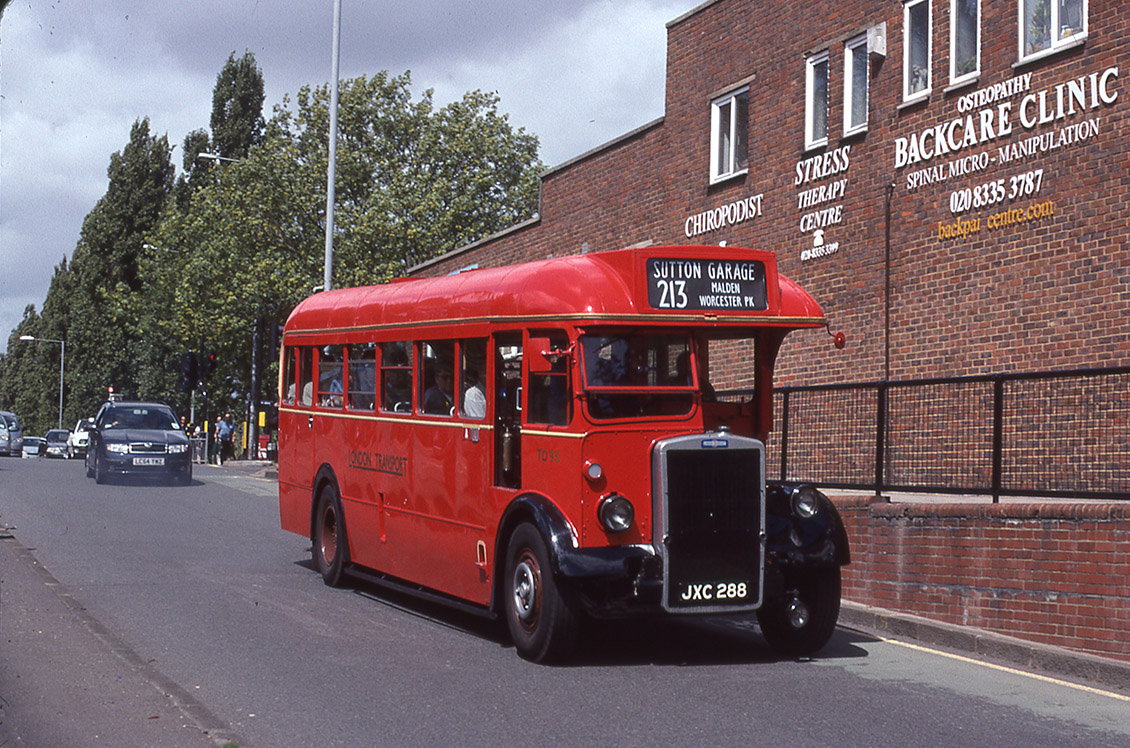
Preserved TD at Worcester Park © David Bowker
The London Bus Museum Shillibeer Place pop-up shop ...
... will be at the Saturday market at Epsom Clock Tower on 13th June with souvenirs, gifts, bus models, books, the 2027 LBM Calendar and much more!
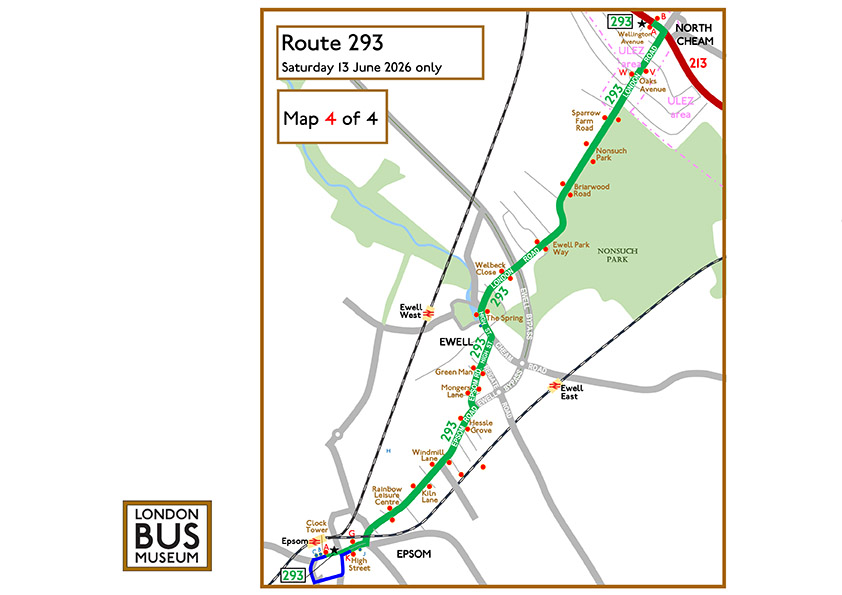
Catch the FREE 293 Heritage Bus from North Cheam to Epsom - every half-hour!
Featured in


Links and downloads
- A brief history of London bus route 213
- A history of Sutton Garage [A]
- Sutton ~ some personal memories by David Thrower
- Photo gallery ~ buses on route 213 taken over the years
- Maps
- Event flyer [PDF]
- Route 213 Public Timetable (Version 4 update 12.06.26) [PDF]
- Route 293 Public Timetable (Version 3 08.06.26) [PDF]
- Feeder Routes 72 (Barnes - New Malden am-only), 711 (Reigate - Sutton), 714 (Dorking - Leatherhead - Hook - Kingston) Public Timetable (Version 1 29.05.26) [PDF]
- Route 213 & 293 Bus List (Version 5 update 12.06.26) [PDF]
- 12th June ~ Revised Timetable for 213 and Bus List added
- 8th June ~ Revised Timetables for 213, 293 and Bus List added
- 6th June ~ Revised Bus List added
- 3rd June ~ Revised Timetables for 213, 293 and Feeder Routes 72, 711, 714 added
- 29th May ~ Timetables for 213, 293 and Feeder Routes 72, 711, 714 added
- 29th May ~ Bus List added
- 7th May ~ History of Sutton Garage added
- 14th April ~ Maps added
Check back regularly for updates.

A brief history of London bus route 213
The London General Omnibus Company (LGOC) opened a new route on 7 September 1921 between Kingston and Lower Kingswood. Numbered 113, it ran via Norbiton, New Malden, Worcester Park, North Cheam, Cheam, Sutton, Belmont and Burgh Heath, using B type single-deckers from Putney garage. The route was part of territorial expansion that year which also included new routes 112 from Kingston to Weybridge and 115 to Guildford and a new agreement with the East Surrey Traction Co to support their expansion to the south, which included route S6 (later 406) between Kingston and Redhill via Epsom.
Within four months, on 4 January 1922, the Sutton to Lower Kingswood section was split off as route 80A and the 113 moved into Kingston garage, which opened that day. The B types were replaced by larger S types that October, still running on solid tyres, and the following January the route was extended to Banstead.
Sutton Garage opened on 9 January 1924 and for the first 6 weeks took over the whole operation on the 113, before the route settled down to be shared by the two garages, a logical arrangement which lasted for 50 years, either with Kingston or nearby Norbiton garages. Sutton replaced its Ss with modern T class Regals in 1930, before both garages put three-axle LT ‘Scooters’ on the route in 1931.
Meanwhile in 1930, the Belmont to Banstead section had been transferred to route 164, one of the routes introduced on the opening of Morden Underground station in 1926. This route was renumbered into the single-deck sequence as 213 in October 1934 and in 1935 rerouted from the direct road between Sutton and Belmont to serve Carshalton Beeches.
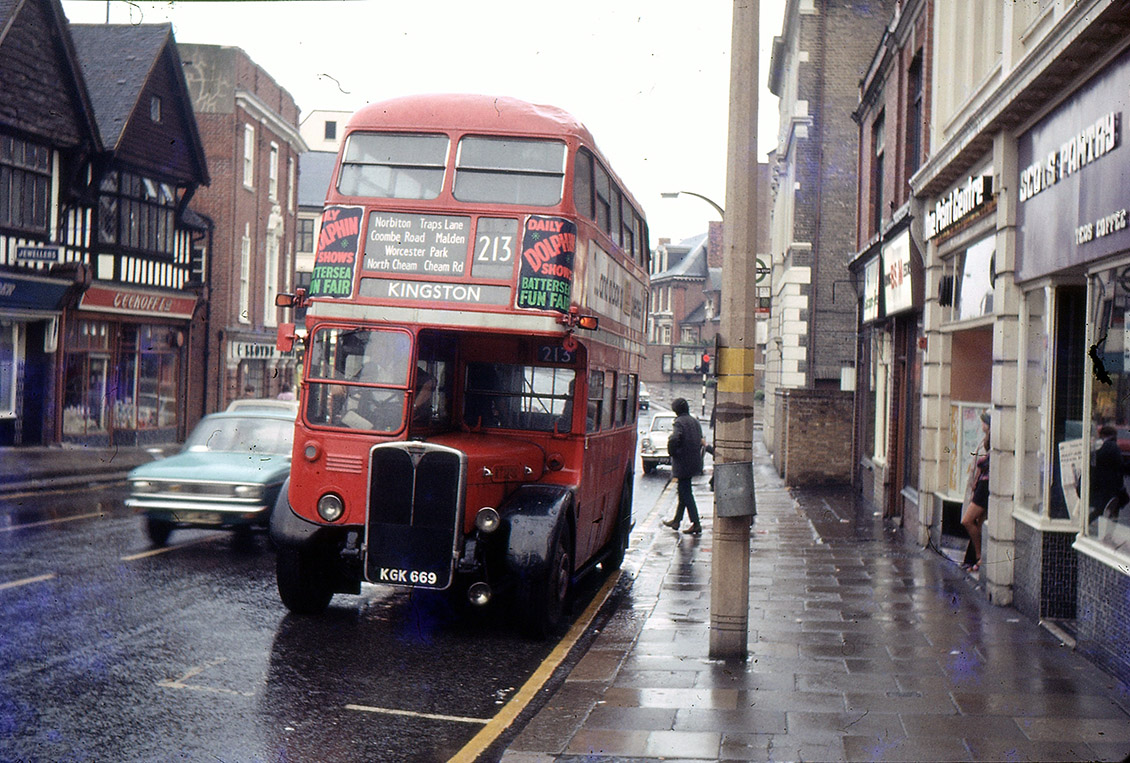
RT1200 is seen in Cheam Road, Sutton, 1972 © Fred Ivey
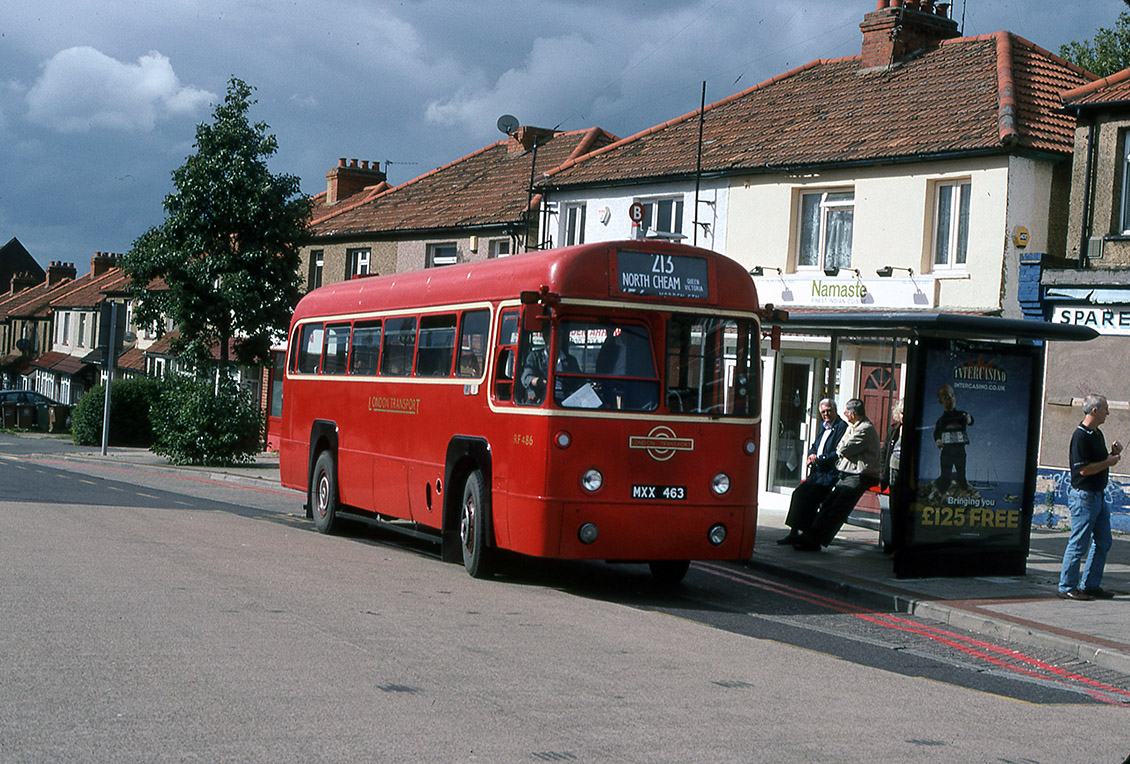
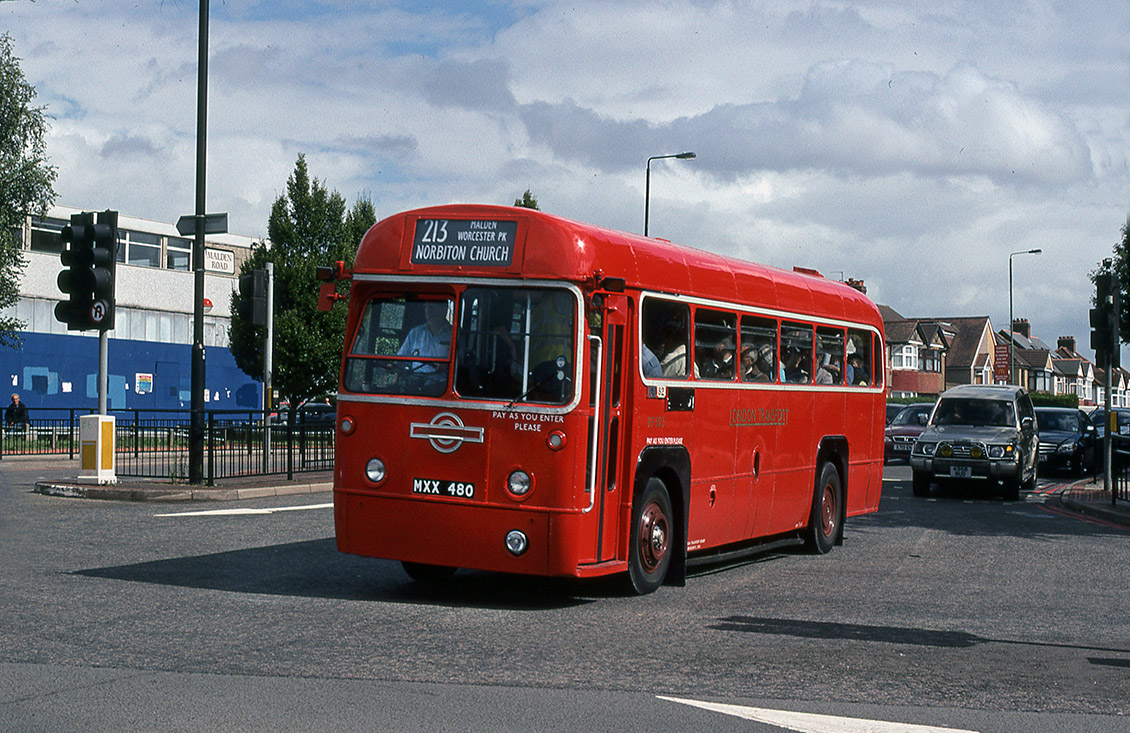
Preserved RF486 at North Cheam © David Bowker
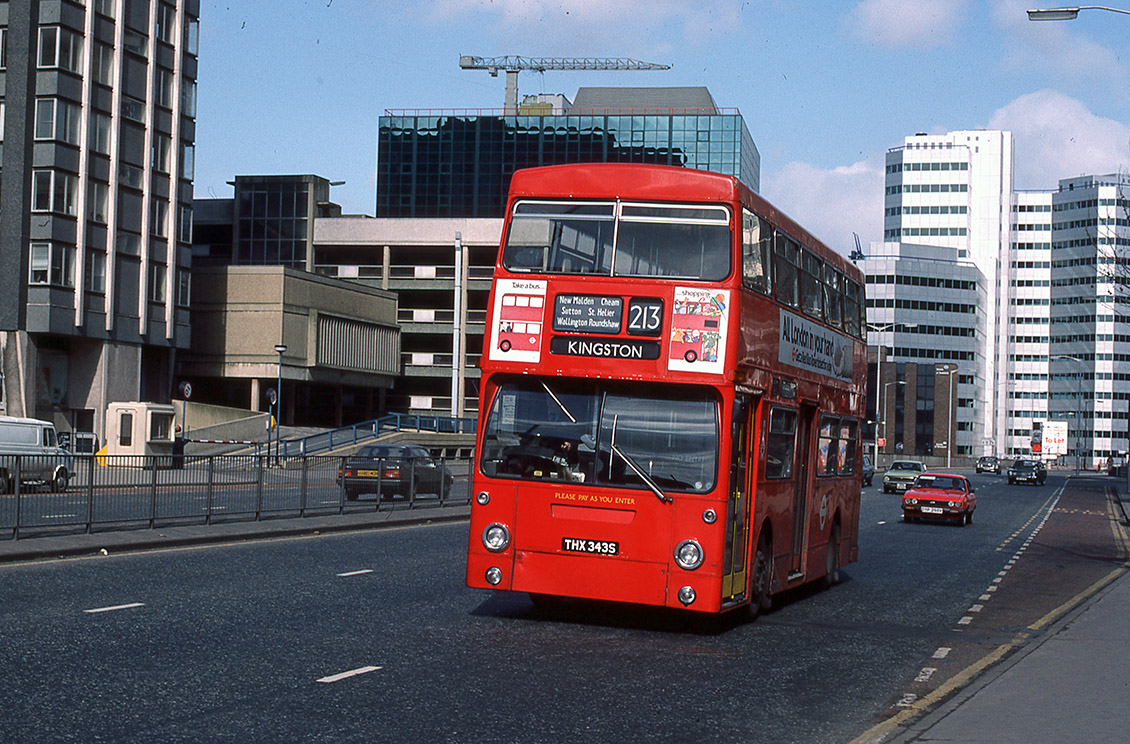
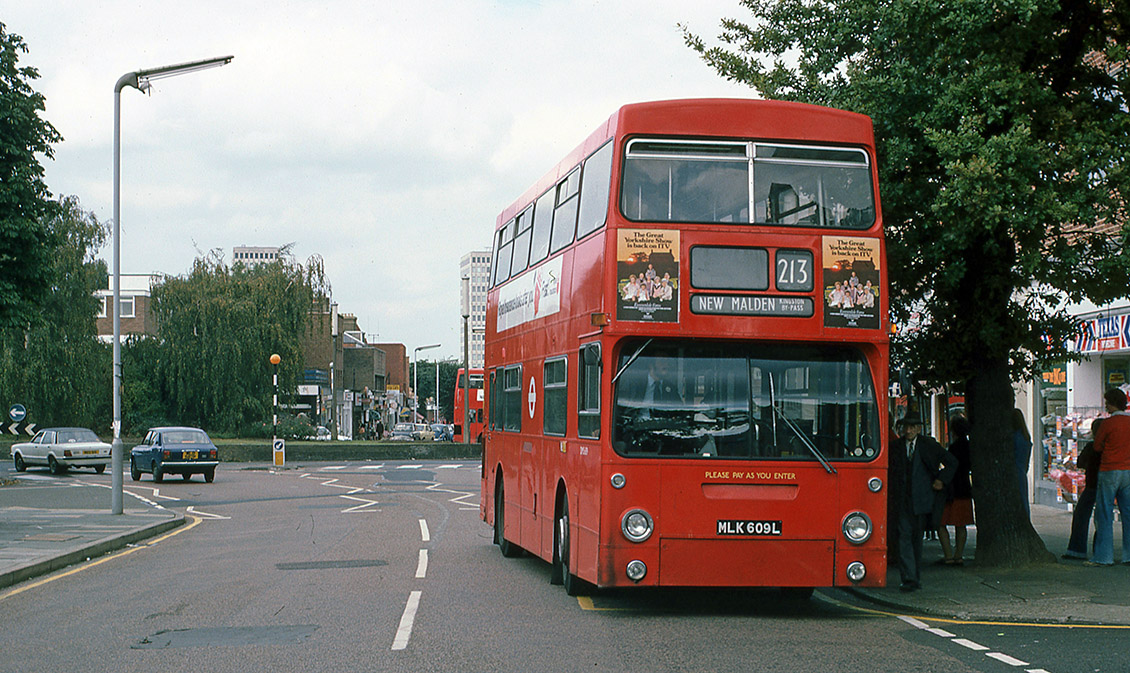
DMS2343 in Wellesley Road, Croydon © David Bowker
In April 1978, the 213A replaced the 213, except for the experimental retention of six shopping hour 213 journeys between Kingston and New Malden, which ceased that October. The 213A continued to be operated by Norbiton and Sutton for six years, until it was renumbered 213 on 4 February 1984.
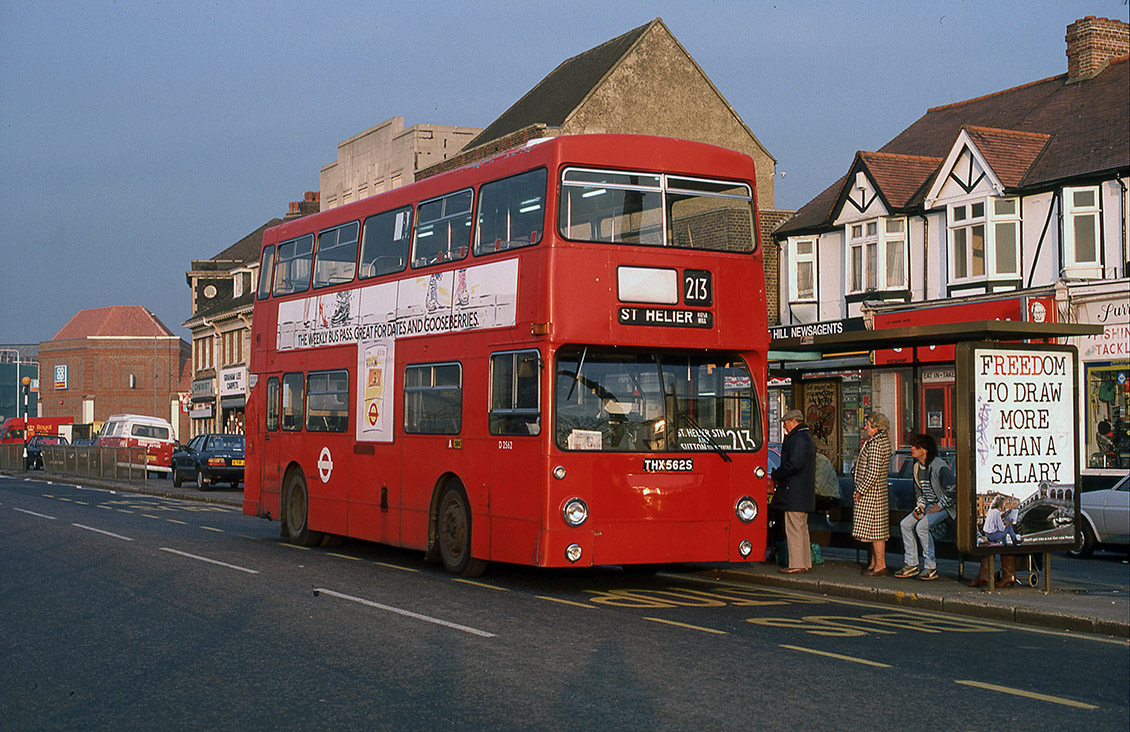
The map of the new 213 from February 1984 looks like an octopus. Running daily from Kingston to Sutton, the route then continued either to Sutton Garage or north to St Helier (Monday to Saturday), south to Belmont (Monday to Friday peak journeys) or, on Sunday, north, south and east to West Croydon via Rose Hill, Carshalton and Roundshaw. Norbiton provided Metrobuses for the majority of the service and Sutton continued with Fleetlines.
The London Regional Transport Act 1984 brought London Transport under Government control. Rather than the deregulation of services occurring elsewhere in the country, London introduced route tendering within a publicly-run framework. The new commercial imperative led to the establishment of operating divisions of London Buses to be run as separate businesses and reduce costs to compete with private operators. One of the early low-cost units was Kingston Bus, based on Norbiton garage, which duly won the first tender to start on 27 June 1987. Norbiton reverted to using Fleetlines, using refurbished training buses, although service was disrupted by industrial action and staff shortages as staff voted with their feet.
A threat by London Buses to hand back the Norbiton contracts (including the 213) and close the garage led to a compromise solution. In the event, a Wimbledon area scheme from 29 October 1988 led to a new tender, again won by Kingston Bus. This involved the withdrawal of the 213 between St Helier and Sutton Garage and a rerouting of the Sunday service to Croydon. However, because the new SuttonBus contracts, which would cover the St Helier section with the 151, did not start for another month, Sutton operated a Monday to Saturday shuttle service numbered 213 between St Helier and Sutton.
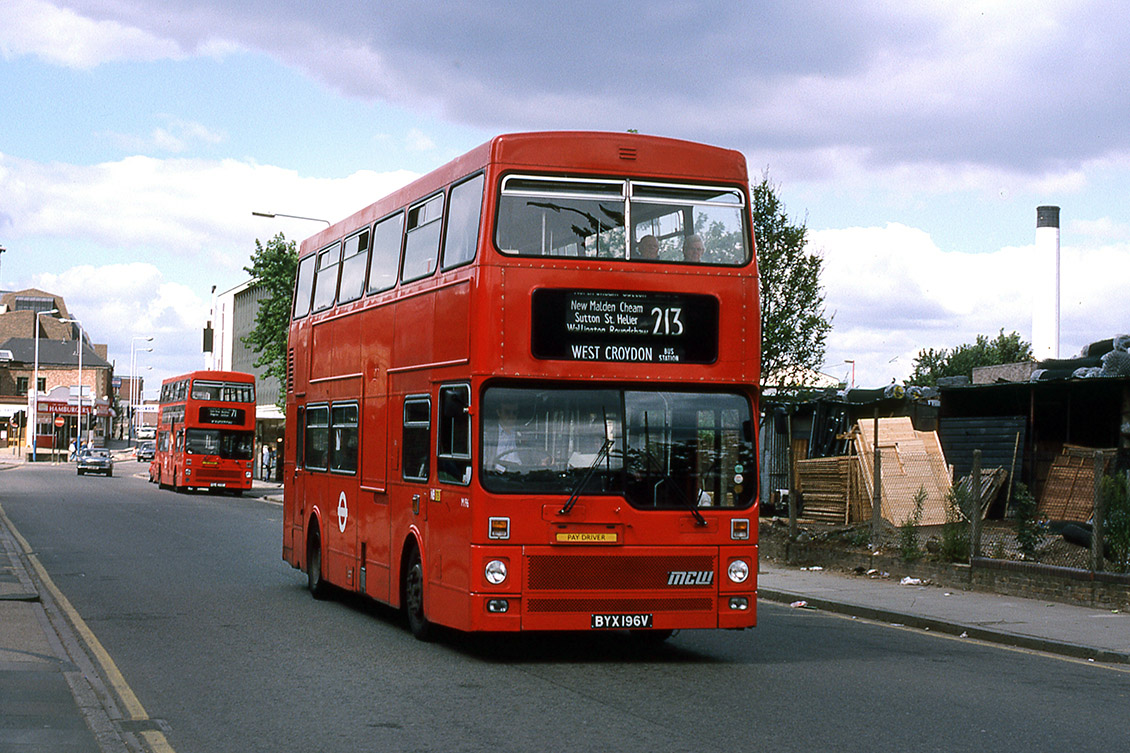
In 1988, London Buses created twelve geographical business units, of which London United included Norbiton and London General included Sutton. London General created the SuttonBus trading unit at Sutton garage, which won the next tender for the 213 from 29 September 1990. This new operation introduced Metrobuses to Sutton, largely transferred from Norbiton, which had lost all three of its tendered routes and closed the following year. The new contract also removed the Sunday extension to Croydon and the peak hour journeys to Belmont, creating the Kingston to Sutton Garage route which operates today.
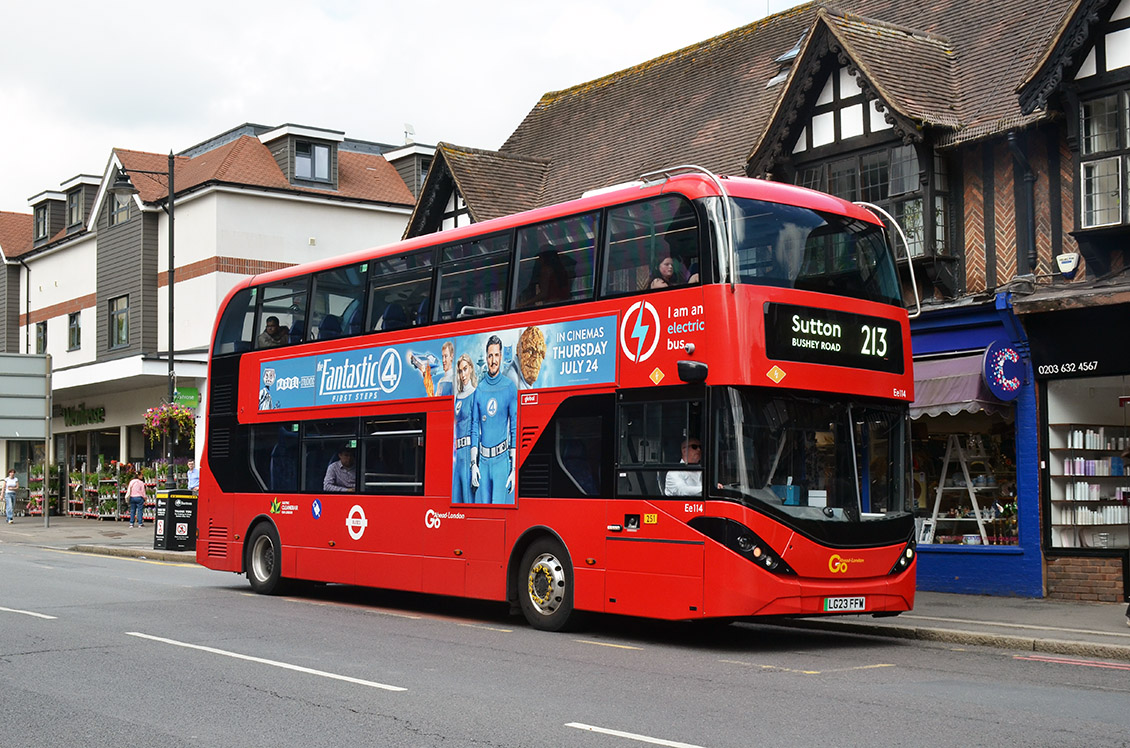
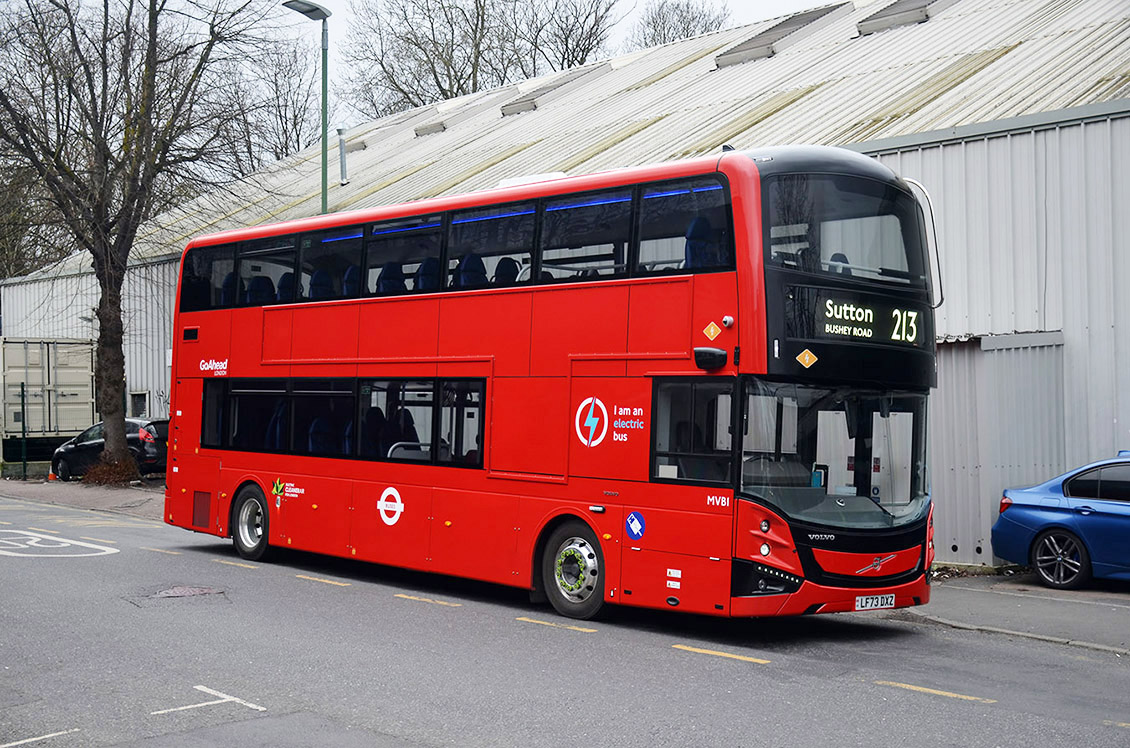
Go Ahead London BYD D8UR-DD / ADL Enviro400EV Ee114 (LG23 FFW); Cheam Broadway; 19 July 2024. © David Harman
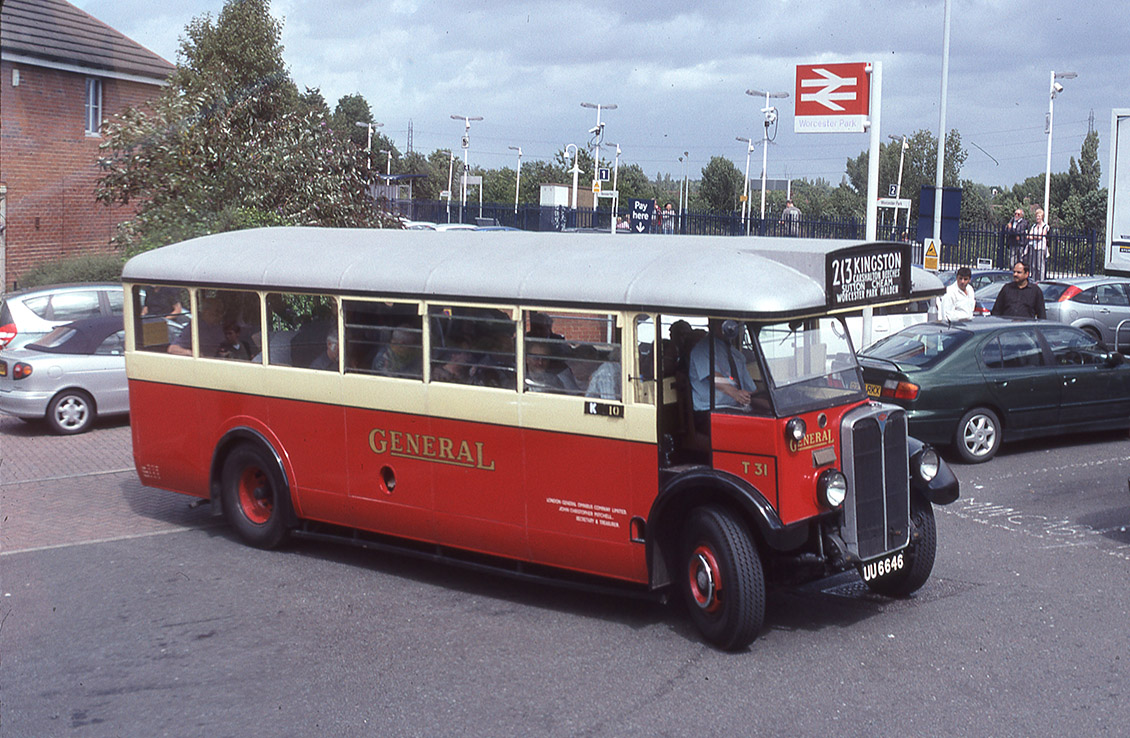
Preserved TD at Worcester Park © David Bowker
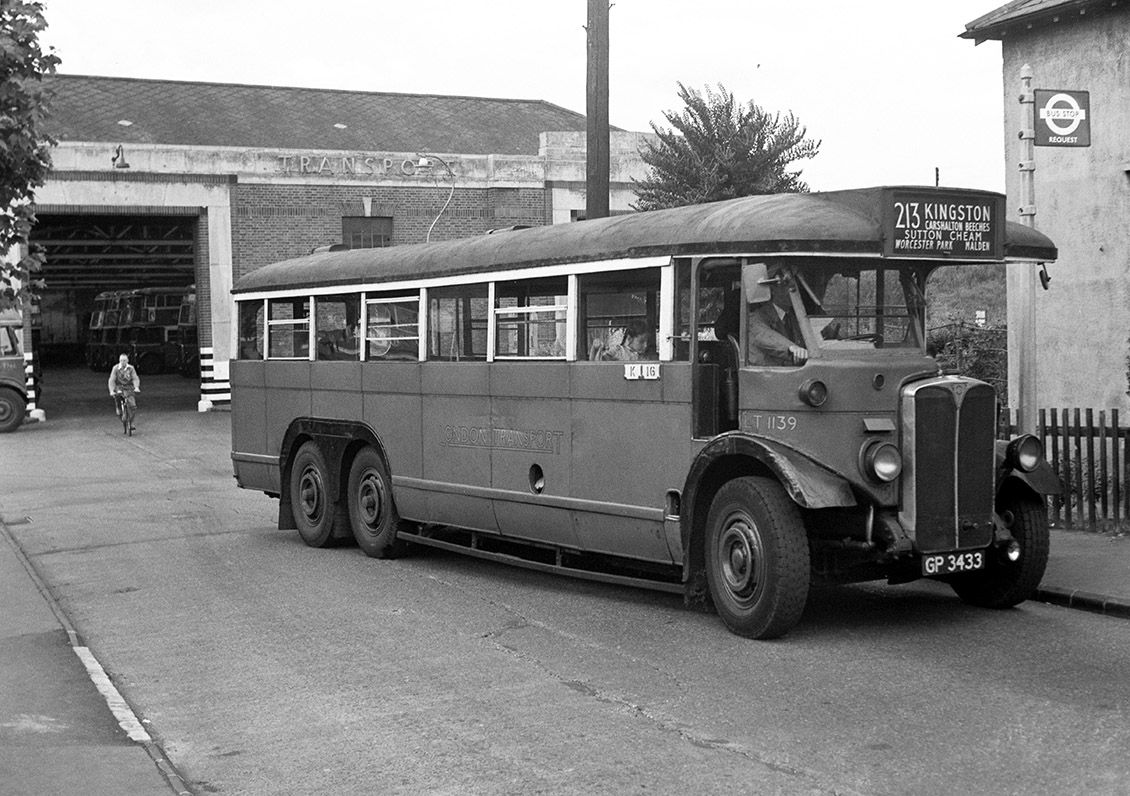
"Scooter" LT1139 outside Sutton garage (note Ds, ST, RTL and a T), 1953 © Fred Ivey
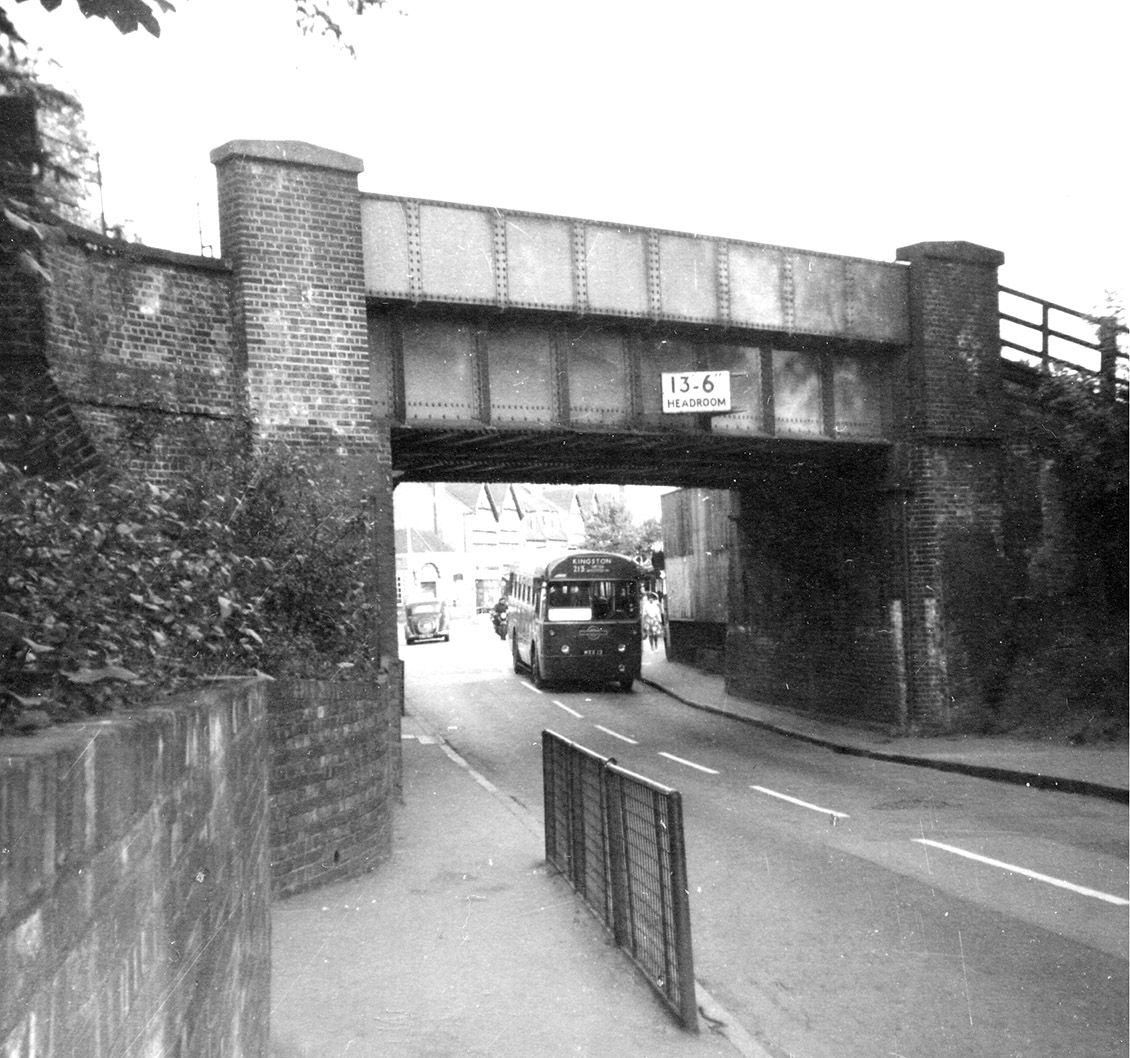
The Scooters operated by Sutton continued to serve the route until conversion to RF in 1952, although Kingston’s minority share varied from time to time to include Ts or Qs, until in 1952 the allocation, by then Ts, was transferred to the new Norbiton garage, seven months before conversion of the route to higher-capacity RFs (still with conductors). Single-deck operation had been required due to low bridges at Norbiton and Worcester Park. The route was diverted in 1962 via Kingston Hill to avoid the former, giving a year for the old route to be forgotten before the lowering of the road at Worcester Park allowed the route to be double-decked with RTs in May 1963.
At the same time, the service was split between the 213 and new route 213A, the latter serving Clarence Avenue rather than Coombe Lane in Norbiton. The section of route between Sutton and Belmont had been transferred to route 151 on Monday to Saturday in January 1962, the Sunday service now being provided by the 213A alone, with the Sutton terminus now Sutton Garage.
Compared with the stability of the preceding 25 years, the 1960s and 1970s saw regular changes to these routes. In February 1964, the Sunday service between Kingston and Belmont was renumbered 213B, whilst Monday to Saturday route 213A was extended to Wimbledon via Sutton Common Road and Morden. The Sunday 213B lasted until November 1964 and was replaced by the 213, while the 213A was reintroduced on Sunday to operate between Kingston and Morden (via Sutton) only.
Kingston RFs had replaced Norbiton’s on Sundays from August 1961 and on conversion to RT, Kingson took over the minority share of both routes, except that on Saturday the 213 was run by Norbiton until early 1964. The 213A was taken over by Sutton in its entirety in 1964. Norbiton returned to the 213 on Sundays in 1966 (with RMs) and replaced Kingston (again) in 1968. It also provided the 213A’s only RMs on Sundays in 1969-70.
In March 1969, the 213A was withdrawn between Wimbledon (Morden on Sundays) and Sutton Garage, and the Sunday service to Belmont switched back from the 213 to the 213A with the 213 withdrawn on Sundays. The Sunday service between Sutton and Belmont was withdrawn completely in April 1970, but at the same time this section was added to the 213 in Monday to Friday peaks from April 1970, in place of the 151. This peak hour service also switched to the 213A from August 1972.
One man operation with DMS Fleetlines came on 5 August 1972, the routes then running as 213 (Monday to Saturday, Kingston to Sutton Garage, by Sutton and Norbiton garages) and 213A (daily, Kingston to Sutton Garage, plus a Monday to Friday peak hour service Kingston to Belmont, by Sutton garage plus Norbiton on Sunday).
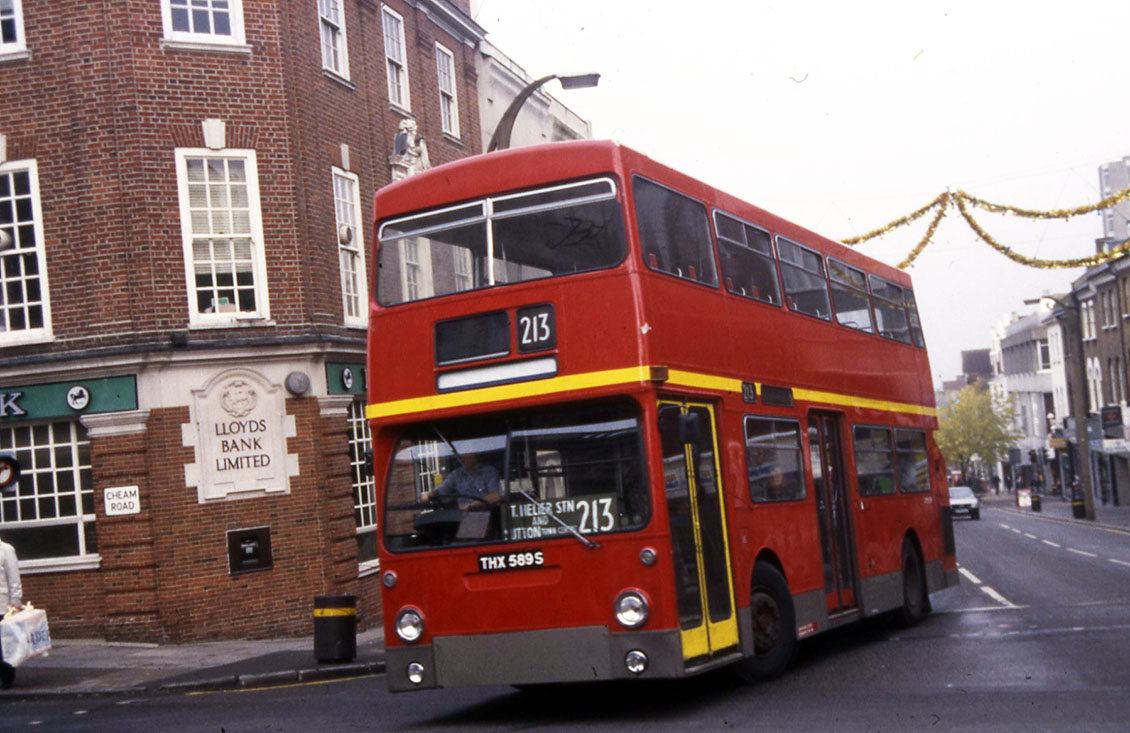
D2589 in Sutton on the temporary St Helier shuttle (in the unbranded remains of SuttonBus livery), 1988 © John Parkin
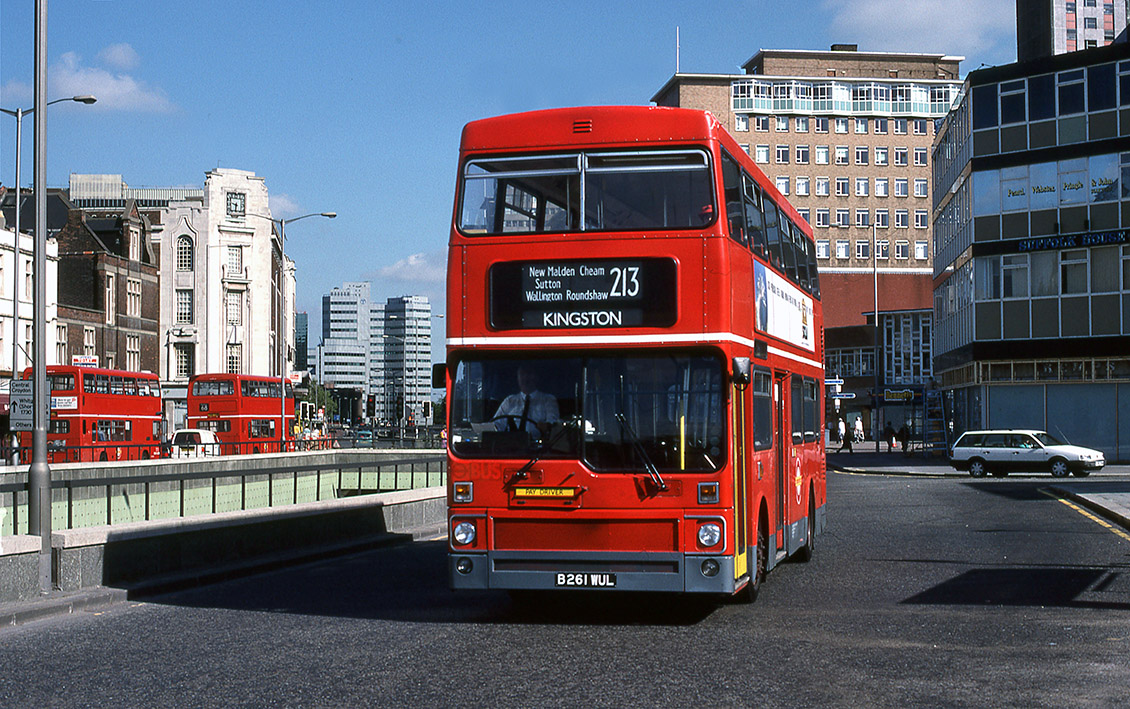
Metrobus M261 in Park Lane, Croydon © David Bowker
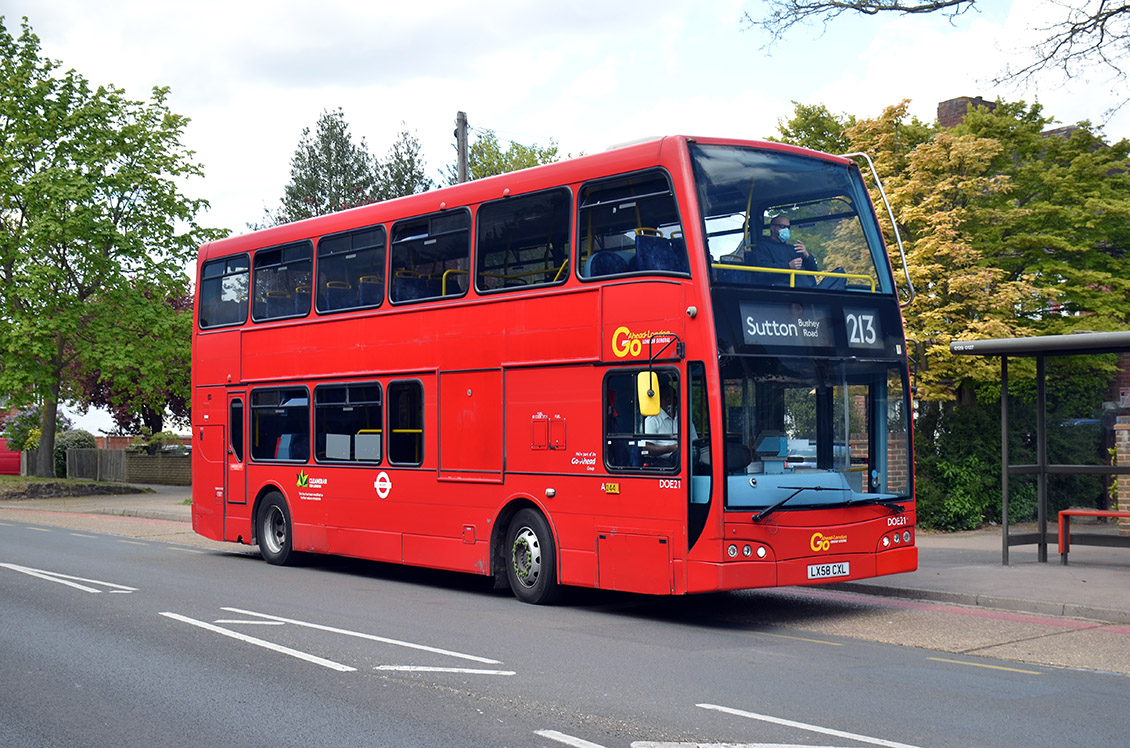
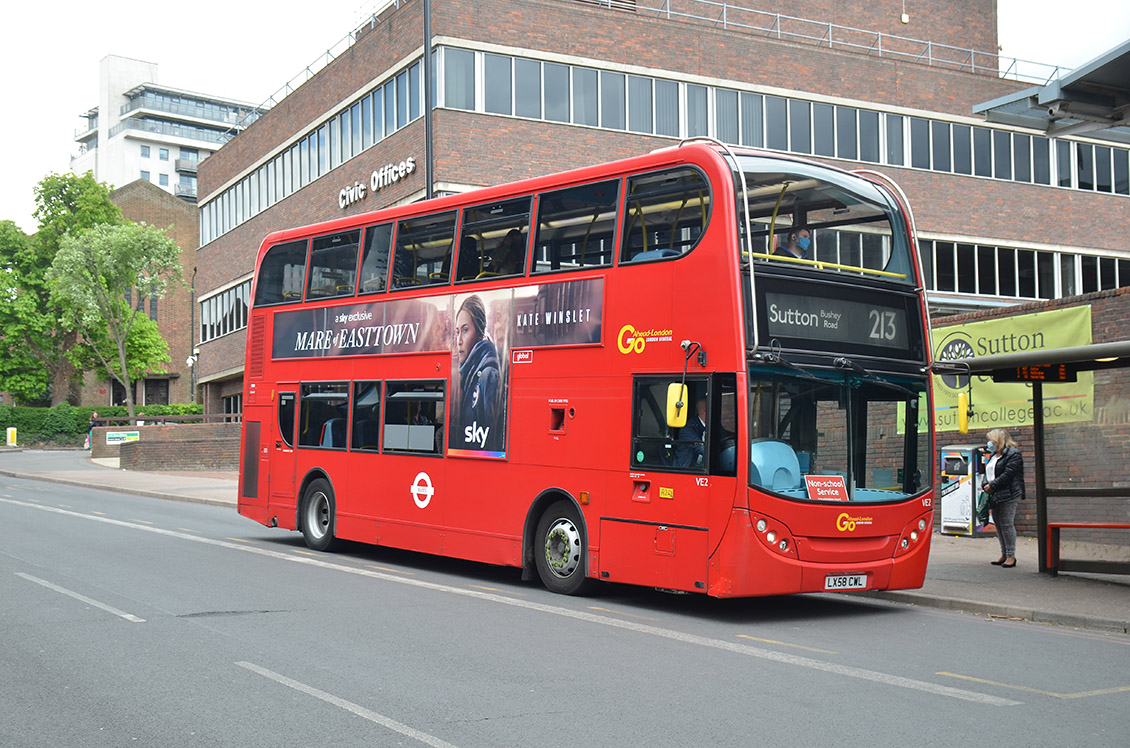
London General ADL Trident / Optare Olympus DOE21 (LX58 CXL); Cheam Road, Sutton; 7 May 2021. © David Harman
London General was acquired by its management in 1994 from London Buses and in 1996 sold to the GoAhead group. London General has won each succeeding tender and continues to operate the route from Sutton garage. The Metrobuses were replaced by NV class Olympians in 1997, which in turn were replaced in 2002 by low-floor EVL class Volvo B7s. Subsequent low-floor double deck classes at Sutton included WVL Wright Volvo B7s, PVL Plaxton Volvo B7s, DOE Optare Tridents, E Enviro400s and WHV Wright Volvo B5s. In 2023, the routes was converted to electric operation using Ee class ADL E400-BYDs and from 2025, Sutton is an all-electric garage.
![Sutton Garage [A]](https://www.londonbusmuseum.com/wp-content/uploads/2026/05/Apsd.jpg "Sutton Garage")
A history of Sutton Garage
Please note that Sutton Garage is NOT open to the public on Route 213 Heritage Day.
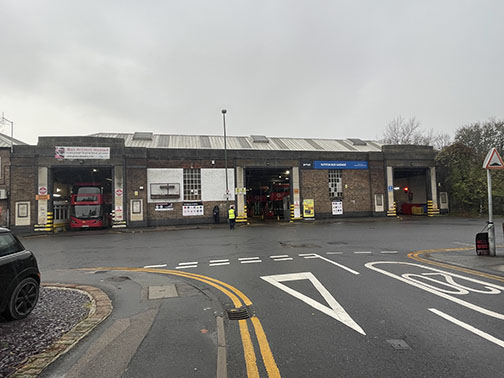
Sutton Garage present day frontage [Peter Osborn]
The London General Omnibus Company opened Sutton Garage on 9 January 1924, the first of five LGOC garages opened that year, built on a ‘fine corner plot’ on Bushey Road north of Sutton. The roof spanned the site with no columns obstructing movement. The adjacent Wimbledon and Sutton railway, which now provides the power for the garage’s electric buses, was one of London’s last new railways, opened in 1930.
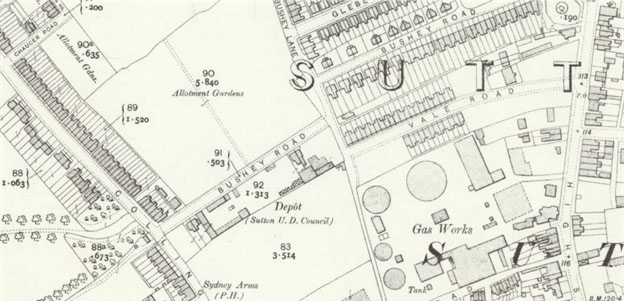
1910
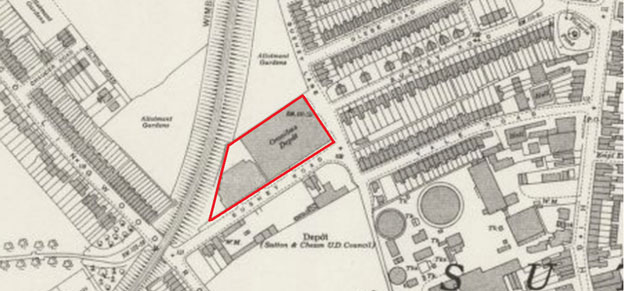
1933
On the opening day, Sutton inaugurated a new route, the 5A (Mitcham to Upton Park), took over complete operation of three routes, 80 (Clapham Common to Lower Kingswood), 80A (Clapham Common to Walton-on-the-Hill) and 113 (Kingston to Banstead), and joined Merton and Turnham Green garages in operating the 88 (Acton Green to Belmont).
The 5A and the 88 were operated with S type double-deckers, the 80 and 80A by K type double-deckers, and the 113 (now the 213) by S type single-deckers. All double-deckers were open top and all ran on solid tyres.
The garage was built to hold about 100 buses although the initial routes required just 33 buses from Sutton for their operation. From November 1924, Sutton took on the majority allocation on the 88, increasing its share from 10 to 32 buses, before handing the route back to Merton in February 1926. The 5A had been swapped for the 88; the remaining initial routes have been operated by Sutton ever since (or in the case of the 80A and successor 280 until the Walton-on-the-Hill service was transferred to London Country route 420 in 1982). By 1930, routes 80, 93E, 113, 156, 157, 164, 165 and 180 (the 80A renumbered) required just 37 buses, but in addition, Sutton periodically operated AW and R class private hire coaches, probably on specific local contracts, as well as providing winter storage for up to 38 coaches in 1928-31.
In September 1926, the extension to Morden of the City & South London Railway (now the Northern Line) opened and was served by no fewer than five new routes, all operated by Sutton using 20 new silver-grey K type single-deckers – these were the first pneumatic-tyred buses to run in London. These were routes 155 (to Worcester Park via North Cheam), 156 (Cheam via North Cheam), 157 (Wallington), 164 (Burgh Heath) and 165 (Banstead). The 155, 156 and 164 had commenced running from Wimbledon Station two months earlier but were then altered to start from Morden. Within two years, all but the 155 were sufficiently popular to be converted to double-deck operation and the silver-grey Ks were repainted red for use elsewhere.
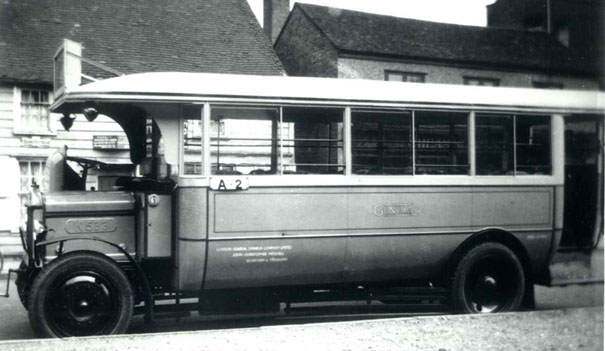
K533 in Cheam Broadway on route 156. W Noel Jackson collection
As the population of the area increased, so the demands on the garage grew. Route 156 in particular showed spectacular growth, from 3 NSs when it was extended in 1928 to form a circle, Morden – North Cheam – Sutton – Morden, to 7 in 1932, 15 in 1933 and 20 in 1934. Overall, the Monday to Friday requirement of the garage increased from 37 buses in 1930 to 106 in 1936, of which 25 were single-deckers. The number of resident buses would be higher due to the need for engineering spares.
During the Blitz, the garage received one direct hit, on the evening of 11 October 1940, when a bomb came through the roof and blew a crater in the centre of the garage floor. Two years later, but probably unconnected, the present canteen was built.
Peak activity was reached, as it was across the whole network, in the early 1950s with a run-out of around 130 buses. A period of managed decline then continued until the 1980s. The garage was modernised in the 1950s and 1990s.
The London Regional Transport Act 1984 brought London Transport under Government control. Rather than the deregulation of services occurring elsewhere in the country, London introduced route tendering within a publicly-run framework. The new commercial imperative led to the establishment of London General as an operating division of London Buses, and the creation by them of the SuttonBus operation at Sutton, under which all existing route contracts were reissued in November 1988 following changes to staff terms & conditions. June 1989 saw the opening of a new low-cost (open air) depot at Colliers Wood (coded AA) to run route 200 and later the 152. Buses based at AA were driven by Sutton drivers but maintained at Merton. AA was later placed under Merton’s control in February 1991, by which time the SuttonBus trading name had been replaced by ‘London General’.
London General was acquired from London Buses by its management in 1994 and in 1996 sold to GoAhead, then coming under the same ownership as London Central.
In early 2023, the garage was converted to operate electric buses. 40 chargers were installed, with two ‘guns’ per charger, plus additional chargers in the maintenance area. Power is taken from the railway running behind the garage. All cabling for the chargers and other infrastructure are fitted in a ladder system within the roof girders.
Bus types operated
Following the initial allocation of double-deck Ks and Ss and single-deck Ss, the first open-top NSs arrived in 1927, replacing Ks. The first covered-top NSs arrived in 1929, progressively replacing Ss, the last of the Ks and then open-top NSs and forming the entire fleet of double-deckers from 1932.
New single-deck Ks arrived for the new routes in 1926 but they and the single-deck Ss were gone by January 1930, when the sole remaining single-deck route, the 113 (later renumbered 213) converted to new Ts. Ss returned briefly in 1931 from Merton with route 87 (later 234), but Ss and Ts gave way to new three-axle LTL ‘Scooters’ in May/June 1931, remarkably long-lived buses the final examples of which lasted until January 1953, to be replaced by RFs.
A brief influx of STs occurred in summer 1932, but lasted only a month. Next generation buses arrived properly from March 1934 with a batch of new crash-gearbox STLs for the 70B, 157, 165C and 88, briefly preceded by a few three-axle LTs for a few weeks, a type which was to make occasional appearances during the 1930s. The STL fleet grew, replacing NSs, and was joined at the end of 1936 by London Transport’s entire fleet of 33 DL Dennis Lances, which although less than 7 years old were withdrawn as non-standard at the end of 1937, just after the last of the NSs. The last scheduled NSs at Sutton operated on, of all routes, the 93, but departed in the middle of 1937.
Up to this point, all buses had been petrol-engined, early diesel buses having been concentrated at a handful of other garages. Between May and September 1939, Sutton’s petrol STLs were transferred out and about 120 diesel STLs arrived, most newly re-engined from petrol. Sutton remained a dual-fuel garage, as the Scooters continued with petrol engines and, as was the case at many garages, the STL fleet was augmented at various times through the 1940s by petrol-engined STs.
In particular, Sutton’s Scooter route 245 – which served factories around the Kingston Bypass - was double-decked (and renumbered 127) in February 1941 using 10 lowbridge Crossley and Leyland buses borrowed from Manchester Corporation. When these buses needed to be returned, five Country Area lowbridge STs were repainted red and sent to Sutton, with the balance of the operation reverting to single-deck. The route and its buses then moved to Merton at the schedule change in October 1941.
The entire batch of new Park Royal ‘relaxed-utility’-bodied Daimlers D182-281 arrived between May and November 1946, releasing STLs; one additional, Brush-bodied D72, was transferred from Merton in December. At 14’6”, the Park Royal buses were too tall for operation from AL, although the rear engineering access door was usable, needed as Sutton was in Merton’s engineering group and all major docking was done at Merton. On delivery in 1946, the double-deck requirement at Sutton was 92. The use of unseasoned timber in their body construction meant short lives, withdrawal being between February 1953 and January 1954. During the Daimler era, Sutton also operated three Daimler CVG6s borrowed from Maidstone Corporation in 1949/50, a period of vehicle shortage.
The RT era arrived with Sutton receiving new Leyland RTLs from November 1952. The decision was then made to concentrate Leylands and AECs into separate engineering groups, with Merton’s group to run AECs, and over 9 months from April 1953 the RTLs were transferred elsewhere and Sutton received 115 mostly brand new RTs. On conversion of the 213 to double-deck in May 1963, Sutton’s entire fleet consisted of RTs.
Sutton’s RT operations ended on 15 January 1977, when the 164 was converted to daily RM operation. RT1892 remained as a spare, which left on 18 November 1977. 25 RMs had arrived on 28 March 1976 to convert the 93 to RM operation, with more arriving in January 1977 to convert the 164. The 164 was then converted to one person operation in March 1979.
The service reductions caused by the Law Lords decision that 'Fares Fair' was illegal (and the subsequent doubling of fares) finally took place on the 4 September 1982, marking the start of mass withdrawal of Routemasters. Route 93 was converted from RM to DM (crew) operation on that date and Sutton became an all Fleetline garage. When all the DMs had been converted for one person operation (becoming Sutton’s second D class), crew operation of the 93 ended on 23 April 1983 and Sutton joined the lengthening list of garages with no conductors.
In June 1987, the first tender for route 213 had been won by Kingston Bus, leading to the entire allocation moving to Norbiton (NB). The next tender in 1990 was won by London General, trading as SuttonBus, using M class Metrobuses. The Ms, which were second-hand from Putney (AF) and NB, were a deliberate move away from the expensive-to-operate Fleetlines. During 1992 all of the latter were replaced by Ms, with D2646 the last in service on 18 June.
Route tendering and new thinking brought low-cost operations to London and led to the use of midibuses from 1987, with Sutton’s first arriving in 1988. They were used on new local routes tendered both by London Buses and by Surrey, including new route 413 introduced to replace the 213 between Sutton and Belmont. The first operation was Surrey route 576 from October 1988 with MRs. Other types followed until most were swept away by the all-conquering Dennis Dart.
The Metrobuses were replaced in 1997/8 by NV class Volvo Olympians on the 93, 154, 157 (which moved to Connex in 2001) and 213, which in turn were replaced in 2002 by low-floor EVL class Volvo B7s. Meanwhile the 80, 151 and 164 had been converted to single-deck using LDP class Darts in November 1996. The LDPs were replaced by Optare Esteem-bodied Darts in 2009. Increasing loadings led to routes being converted back to double-deck operation, the 151 in 2006 and the 80 in 2021.
In a TfL trial of on-demand buses, ‘Go-Sutton’ was introduced on 28 May 2019 with 6 white-liveried Mercedes Sprinter minibuses based at Sutton garage. Whilst the trial was curtailed due to the Covid pandemic, TfL concluded that ‘DRT’ was not cost-effective.
Subsequent low-floor double deck classes at Sutton included WVL Wright Volvo B7s, PVL Plaxton Volvo B7s, DOE Optare Tridents, E Enviro400s and WHV Wright Volvo B5s. Between 2023 and 2025, Sutton’s allocation on all routes have been converted to electric operation, using Ee class ADL E400-BYDs, plus the latest DEL Wright Electroliners for the 151. The single-deck S2 uses SEe class ADL E200-BYDs.
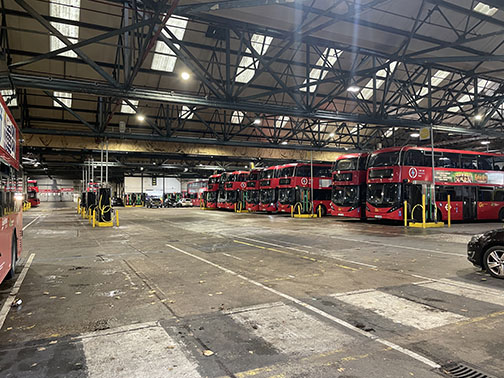
Sutton Garage showing electric charging points [Peter Osborn]
Current routes (total 86 buses)
Route 80 (7 buses)
One of the original routes taken over by Sutton on opening in 1924 and operated by the garage ever since, through various changes of route, although since conversion to electric, half of the service has been provided from a Merton outstation with diesel buses. The 80 ran to Kingswood and the 80A to Walton on the Hill, both destinations left to London Country services from 1982 with the 80A withdrawn. On conversion of both routes to one person operation (with RFs) in 1969, the northern section became the 280; operation of the 280 moved to Merton at the start of SuttonBus in November 1988.
![BYD-ADL-400EV-Ee170-Morden-19-July-2025 [David Harman]](https://www.londonbusmuseum.com/wp-content/uploads/2026/05/BYD-ADL-400EV-Ee170-Morden-19-July-2025.jpg "BYD-ADL-400EV-Ee170-Morden-19-July-2025 [David Harman]")
BYD-ADL-400EV Ee170 - Morden - 19 July 2025 © David Harman
Route 93 (26 buses)
In 1924 the British Empire Exhibition (incorporating a new football stadium) had opened at Wembley. One of the new bus routes introduced to serve the exhibition was route 93 from Putney. The route continued after closure of the exhibition in 1925, running between Harrow Weald and Wimbledon. Sutton garage became involved in May 1930 when a section of the route was extended to Morden (from Putney Bridge as route 93C) and on to Cheam via North Cheam (as 93E) in September. The section north of Putney Bridge was finally withdrawn (after many changes) with the outbreak of war in September 1939 and the 93 became Sutton’s ‘premier’ route, the garage taking full control from 1978.
Meanwhile, the daily Morden – Dorking section (the 70D) of LGOC route 70 (Clapham Common – Dorking, renumbered from 107 in 1924 and on which Sutton had occasional Sunday work) had been transferred to operation by East Surrey Traction Co in 1930. The full route was restricted to Sunday working and the weekday Morden to Epsom section (as 70B) was taken over by Sutton in 1931. At the end of the Bassom numbering system in 1933, both Central and Country areas ran as route 70. This unique arrangement ended in 1938, with the Country route being diverted at Ewell as route 470 Dorking to Warlingham and the Central route being largely replaced by the extension of the 93 to Epsom and (on Sundays only) Dorking.
The 93 has run between Putney Bridge and North Cheam since 1970 and now utilises almost one third of the buses based at Sutton. Operation is with Ee class electric double-deckers.
![BYD-ADL-400EV-Ee199 -Putney Bridge-19-February-2025 [David Harman]](https://www.londonbusmuseum.com/wp-content/uploads/2026/05/Ee199.jpg "BYD-ADL-400EV-Ee199 -Putney Bridge-19-February-2025 [David Harman]")
BYD-ADL-400EV Ee199 - Putney Bridge - 19 February 2025 © David Harman
Route 151 (15 buses)
Started in 1941 to serve important industrial sites in Hackbridge, the 151 initially was a peak hour route requiring 27 STLs from Sutton. After the war, the route settled down as a regular weekday route but at a much reduced frequency, extended in 1961 from Morden and North Cheam to Sutton and in 1962 replacing the 213 between Sutton and Belmont. A staff overtime ban in 1966 led to the suspension of the route and its replacement over key sections by Carshalton Belle and Paynes Coaches. Replaced to Hackbridge by Merton MBS route M1 in 1968, the route withered and died in 1970, although the resulting lack of service to Belmont between the peaks led to a short-lived RF route which confirmed the lack of demand.
A new 151 between Worcester Park and Wallington commenced in 1984 and has been operated continuously by Sutton ever since. The route received new Wright Electroliners in March 2025.
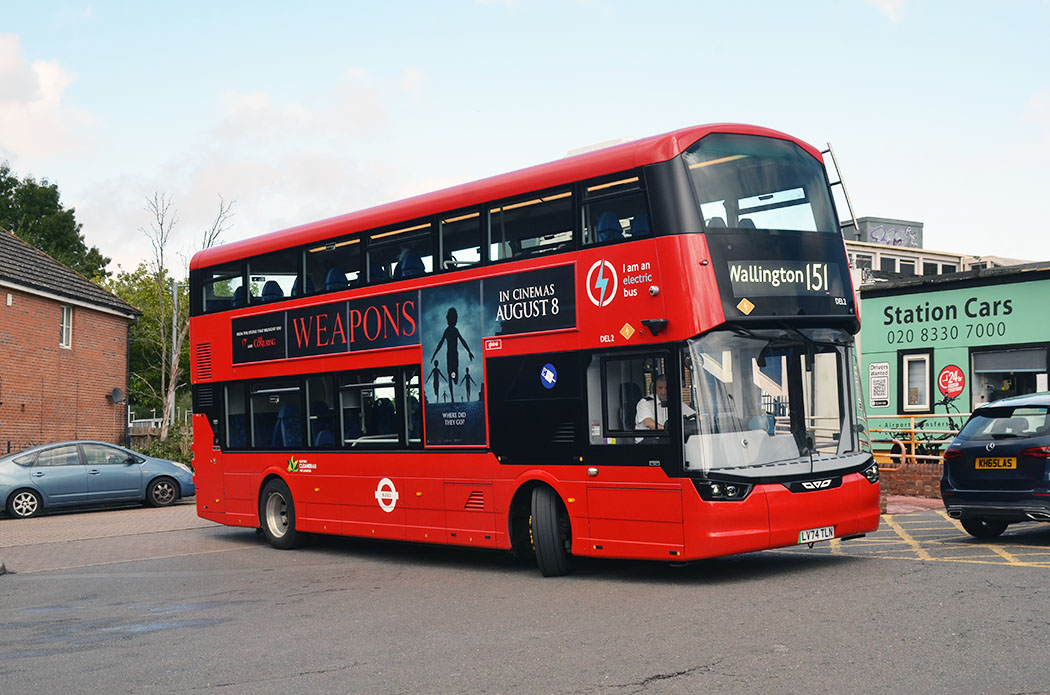
Wright Streetdeck Electroliner DEL2 - Worcester Park - 19 July 2025 © David Harman
Route 154 (16 buses)
Route 154 marked the start of the London trolleybus conversion, being a replacement in March 1959 of trolleybus 654 and worked by Carshalton garage, the former Sutton tram and trolleybus depot. Operation moved (in part) to Sutton on the closure in January 1964 of Carshalton garage. Sutton has had sole operation since 1981, through variations to the route. Operation is now with Ee class electric double-deckers.
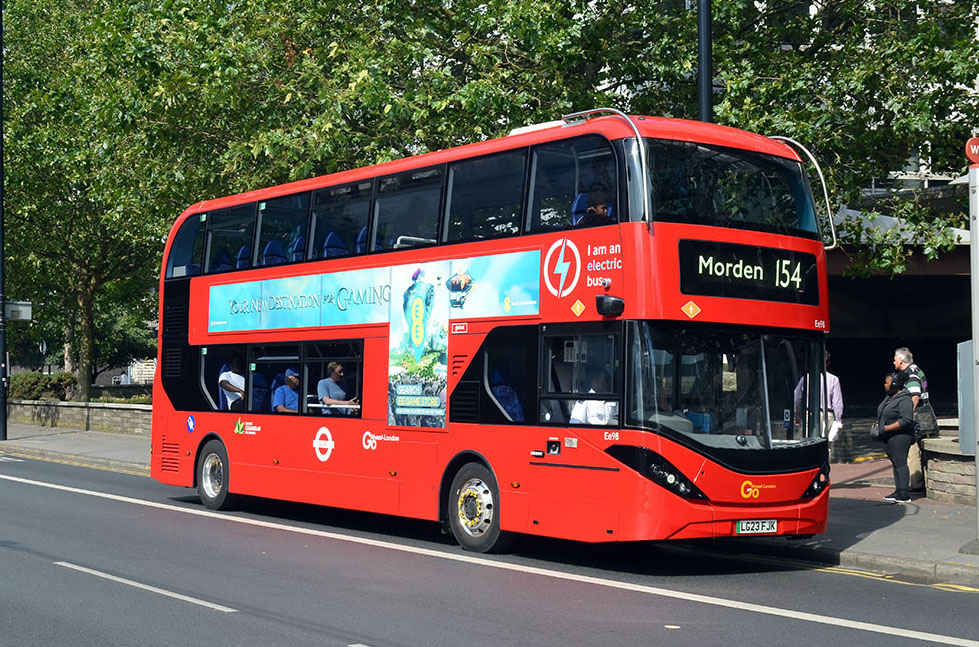
BYD-ADL-400EV Ee98 - Wellesley Road, Croydon - 16 August 2023 © David Harman
Route 213 (14 buses)
With the exception of three years 1987-90 when the first tender contract was won by Kingston, this Kingston to Sutton route has been operated by Sutton (initially as the 113) continuously since the garage opened in 1924. Double-decked in May 1963 following the lowering of the road under the railway at Worcester Park, the route is now operated with Ee class electric double-deckers.
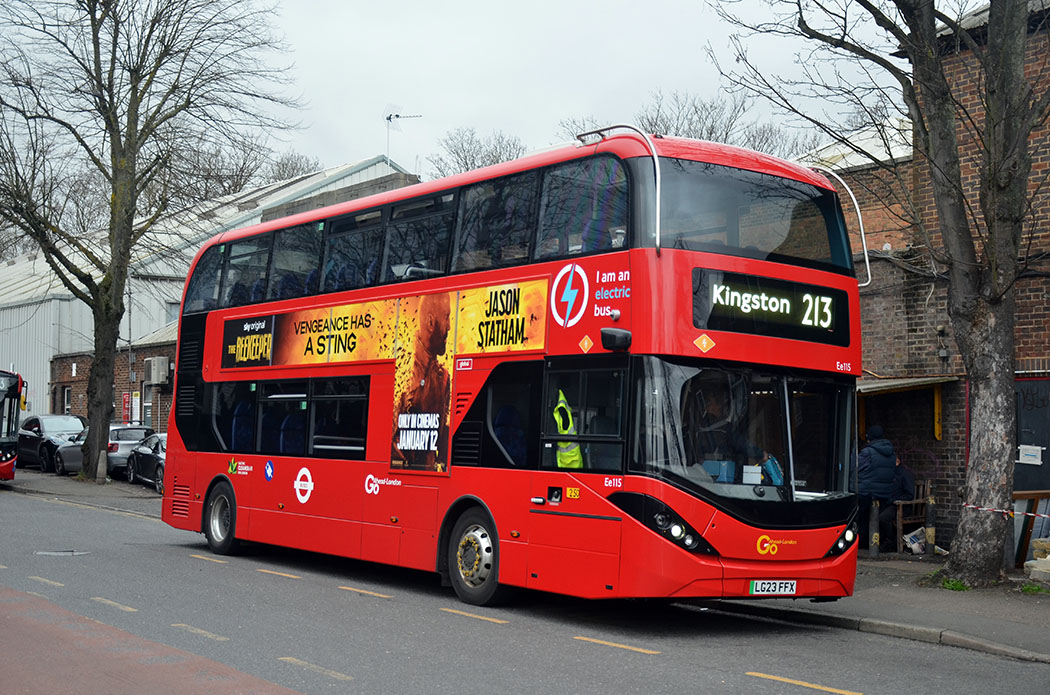
BYD-ADL-400EV Ee115 - Bushey Road, Sutton - 17 February 2024 © David Harman
Route S2 (8 buses)
S2 is a new route between St Helier and Epsom, operated from its introduction in March 2024 by electric single-deck ADL-BYD buses. It replaced parts of ‘back roads’ routes 470 and S4.
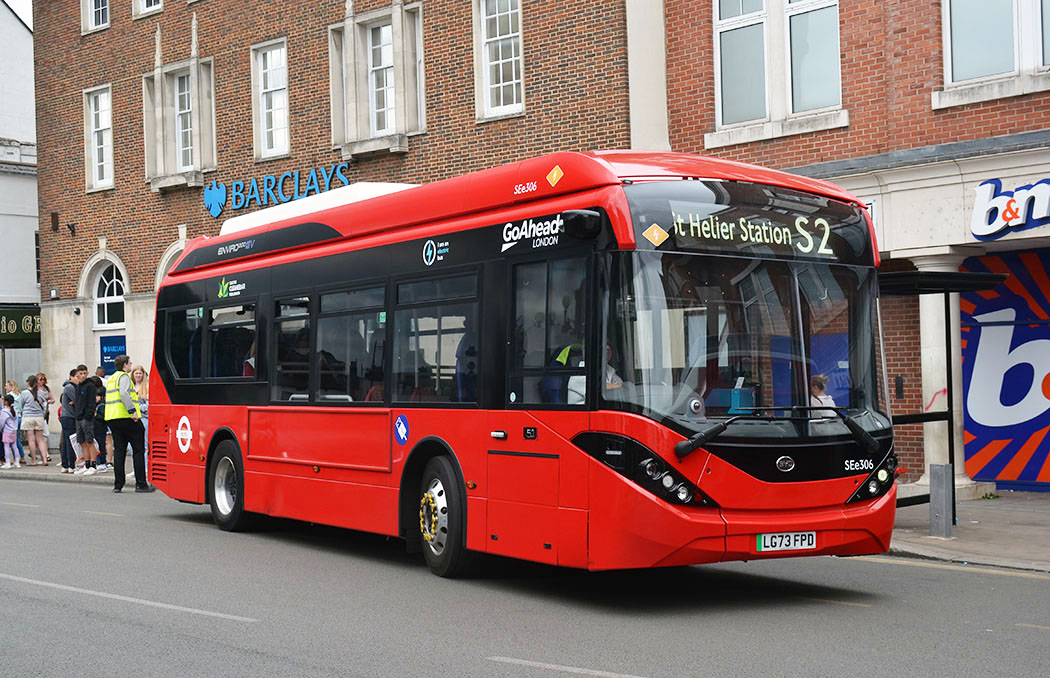
BYD-ADL Enviro200 EV SEe306 - Epsom, High Street - 9 June 2024 © David Harman
Appendix A
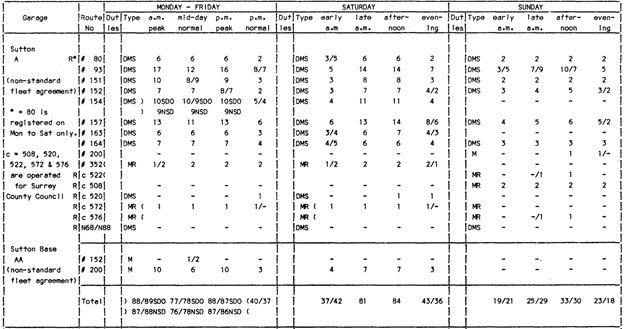
Routes and buses operated – Allocation Book extracts - click on images for PDF
31 December 1930 (S, NS, T)

9th December 1936 (NS, DL, STL, LTL)

27th October 1943 (STL, LTL)
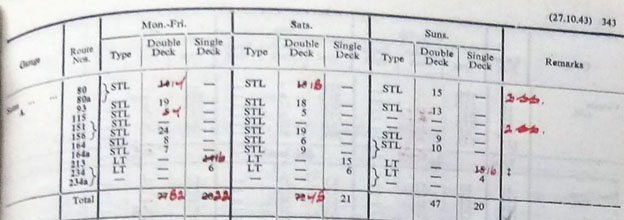
22nd October 1952 (D, LTL)

17th June 1967 (RT)

24th April 1982 (RM/DMS)

2nd June 1990 (DMS, MR, M at the AA outstation at Colliers Wood)
References
Motor Omnibus Routes in London: London Historical Research Group of the Omnibus Society
London Transport Bus Garages since 1948, J Joyce: Ian Allan 1988
LOTS newsletters
LHRG archives
Sutton ~ some personal memories by David Thrower
If there is one place that, in my admittedly biased mind, epitomises the comfortable outer London suburbia of the 1950s, and the London Transport bus network that served it so well, it is Sutton, Surrey. This was the era of by then well-established pre-war suburban houses and gardens, long sunny summers and genuine snowy winters, the BBC Home Service, sweets and ice lollipops that you could buy for one penny, and the novelty, still only for a minority, of television (but at that time only two channels). Of Harold Macmillan’s “You’ve never had it so good”, of Bill Haley’s Rock Around the Clock and Nat King Cole’s melodies, and of course of the superb London Transport RT and RF bus fleet.
The town of Sutton is older than you might think. It was recorded as a small hamlet as far back as the Domesday Book (1086), but really began its growth as a place to exchange horses for the stage-coaches running between London and Brighton. The arrival of the railways in 1847 greatly-boosted the development of the town. Growth positively exploded during the early 20th century, and in 1934, during a period of particularly great expansion, the Borough of Sutton and Cheam was created.
At this time, Sutton was still administratively in the county of Surrey, and indeed even in the 1950s we still wrote “Sutton, Surrey” on letters, but the creation of almost-continuous housing development, particularly to the west, north and east, and the ever-growing importance of rail commuting into Central London, resulted into its inevitable absorption into the Capital, becoming the London Borough of Sutton in 1965.
A Personal Link
Like the former Prime Minister John Major, so I recently discovered, I was born at St Helier Hospital, just north of Sutton, in 1950, spending my first four or five years in Morden, within walking distance of the Underground station. This was at a time when London Transport was still recovering from the Second World War that had ended just five short years previously. For its bus services on the very busy Morden-Sutton corridor, in the late 1940s, LT had famously brought in a fleet of 100 wartime “Utility” Daimler double-deckers, with pre-select gears, based at Sutton Garage, and I can just about remember these at Morden.
Why was I interested in buses? My maternal grandfather (my mother’s Dad) worked, as he had since the mid-1930s, at the well-known Weymann bus factory at Addlestone, Surrey, commuting from Lower Morden by 118 bus to Raynes Park and then Southern Electric train. He used to bring home old trade magazines, and to keep me amused I was given back-number copies and permitted to cut-out the pictures with those well-remembered children’s rounded-tip scissors and paste them with Lion gum into a scrapbook, sitting by the (coal-fired) hearth.
Thus it was that, even at three, I was closely interested in buses. Whenever we travelled from Morden to St Helier Hospital (my late Mum, who remarkably lived until 2025, by then almost 102, would have been expecting my younger sister), we would use the 164/164A route, and as a pre-school infant she would lift me up high to check the bus-builders’ body-plate on the staircase bulkhead of each bus, to see if it was “one of Grandad’s (Weymann) buses”. I recall this as clearly as if it were last week, but we are talking 1953 here, and the buses were almost-brand-new RTL Leylands, most of which would in fact have had Park Royal bodywork.
And so the London Transport network, particularly the 164/164A bus from Morden station to Epsom/Tattenham Corner and the 118 from Morden station to Raynes Park, together with the Northern Line, with its strange station-names such as Colliers Wood (coal mines in South London?), Oval and Tooting Bec, formed my infant transport upbringing.
And even as a very small boy, I appreciated the excellent interchange arrangements at Morden, with those fascinating semi-streamlined1938 Underground trains downstairs at the platforms and an array of smart red double-deckers waiting up the stairs right outside the station doorway. And the stylish yet subtle beauty of the RT-family buses and Tube stock. The RT-types and RF single-deckers in particular impressed me, and I certainly never dreamed that, seven decades later, I would end up restoring and maintaining four of them.
Sutton The Town
Trapped between Kingston to the west and Croydon to the east, Sutton the town was like a pin between two magnets, caught betwixt the competing pulling-powers of these two very large outer-London shopping centres. In 1963, Sutton was listed as having a population of 79,000, about the same as Sutton Coldfield in the Midlands.
But it was always very difficult to grasp just how large or small Sutton was, because it simply merged into the neighbouring centres. In clockwise order, these were Morden to the north, then Mitcham, then Wallington and Croydon to the east. To the south-east and south there wasn’t much in terms of centres, only leafy-suburb Carshalton Beeches and Belmont. Then to the west was Cheam, of comedians Tony Hancock, Sid James and Bill Kerr fame, and beyond lay Worcester Park and Kingston.
The shopping centre was always bustling, except on Sundays when virtually all shops were closed. My main memories of the shops in Sutton were of a medium-sized department store, Shinners, on the west side of the High Street, and a stationers called Pyles or Piles on the east side - I think it was called Pyles/Piles Corner, where you could buy BIC biros (a very new invention, most pens at that time used liquid ink) for a shilling (5p). Shinners was in later years taken over by United Drapery Stores and later still was to become Allders in 1979. There was also a shop at the Sutton Green (north) end of the town that sold model railways, and I recall admiring a very expensive Hornby-Dublo train set in its window, featuring the Duchess of Montrose Pacific locomotive, that would have set an office or shop worker back well over a week’s wages.
Sutton was not, most regrettably, on the London Underground, and you had to travel to Morden for that, but it stood at the convergence of several busy Southern Electric rail routes to Victoria and London Bridge, West Croydon, Horsham and, via a relative upstart of the interwar years, a branch to Wimbledon via St. Helier that had only opened as recently as 1930. There was also a short branch to Epsom Downs, which became extremely busy on Derby Day.
None of these lines excited much interest for rail enthusiasts, their services being operated by vast numbers of 4-SUB suburban electric units as they wandered round and round South London in endless circles, although you might occasionally spot a steam locomotive on a local pick-up goods train if you were very lucky, a memorable day!
Sutton’s Bus Network
To a bus enthusiast, Sutton’s appeal was very considerable indeed. The road pattern of the area was defined by a north-south-east-west cross, with the north-south of the old Brighton Road forming the High Street, and intersecting there with the west-east of Cheam Road and Carshalton Road.
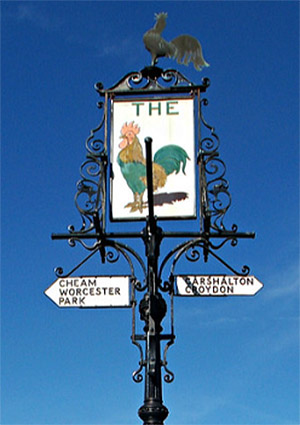
The intersection was at the south end of the High Street, almost at the top of a low hill, and was marked by the Cock Hotel inn sign that had been relocated by a few metres to there in 1914-15 when the inn itself had been demolished. The magnificent Grade 2-listed inn sign happily still survives today. At this key point, the north-south bus routes from Morden crossed paths with the west-east routes from Epsom and Cheam to Croydon, giving the young bus enthusiast being dragged round the shops a great place to watch buses.
By this time, having moved to Sutton as a (just) five-year-old, we lived near the extreme north end of Sutton High Street, near Angel Hill. Sadly we were not on a bus route, indeed we seemed to live in a vast swathe of suburban roads completely unserved by buses, which were a good ten minutes’ walk away from the nearest stops at the south and north end of Angel Hill, where there was (and is) a footbridge that afforded the exciting opportunity of watching the shiny red roofs of RTs pass beneath your feet. On one occasion at Angel Hill, I spotted RT 9, the lowest-numbered working RT I ever saw, by then demoted to driver-training duties. I recall the moment as though it was an hour ago.
After another change of school at age seven, my new prep school was right at the extreme southern end of the town, on the Brighton Road a couple of stops south from the Southern Electric station. This gave me my very first experience of commuting, on the 80, 80A, 164 and 164A routes (all RT-operated), with each single journey costing the grand sum of 1.5 old pennies (just over half a penny in today’s money). It seems amazing now to think that fares started so low.
But my early travels were soon to come to an abrupt halt when the infamous 1958 bus strike broke out. It lasted for no less than seven weeks, from 5th May until 20th June 1958, resulting in the axing London-wide of numerous routes, several garage closures and the withdrawal of no fewer than 646 buses and trolleybuses. This in turn resulted in the selling-off of hundreds of excellent RT and RTL buses, some only a four of five years old. Provincial bus operators, especially in Scotland, were not slow to purchase many bargains.
In the meantime, back in Sutton and still age seven, a very long (2km)) walk to school became the norm for me. But for thousands of others it marked a permanent transfer to bicycles and trains or the purchase of mopeds, motorcycles and cars. It was a lasting setback to the London Transport bus network that had been so successfully modernised since 1947 when the first of all those thousands of new RTs had arrived.
No attempt is made here to detail the history of Sutton’s bus network, which had become well-established in the 1920s at the time when motorbuses themselves first became mechanically reliable. By the mid-1950s, the RT/RF era I recall so vividly, Sutton’s major routes were (on the north-south axis) the 80/80A, 164/164A, and Green Line route 711. On the west-east axis, the main routes were the 213, 408 and 470, these last two of course being operated by green London Transport Country Area RTs that always looked a little out of place in London red-bus suburbia.
The 80/80A routes had a history stretching back to 1916, and later had been operated with Sutton’s Utility Daimlers immediately after World War II, before briefly using brand-new Leyland RTLs until these were displaced by AEC RTs in 1954. The RTs were to monopolise both routes for 15 years, until the conversion to one-man (later more accurately renamed one-person) operation by RFs in 1969, when the Mitcham-Sutton leg was renumbered 280. The RFs held sway until 1976, when they were to be replaced by Bristols, the RFs thus completing a quarter of a century of service at Sutton, a fine record.
The one route I have absolutely no memory of was the 88, which was Acton Green to Mitcham with some extensions (weekday peaks and Saturdays) to St Helier, presumably to serve visitors to the hospital, and then further extended to Sutton and Belmont on Sundays. The reason is doubtless that I wasn’t wandering around Sutton High Street on a Sunday, being either indoors or away visiting grandparents near Raynes Park, and so probably rarely if ever set eyes on it. Its presence and relevance in the 1950s came as a complete surprise in the 1980s when organising sets of destination blinds for my preserved RT 2794, which I had purchased in 1983.
The Sutton red-RT routes I remember best were the 164/164A. These linked Morden station with Sutton and Epsom (164) or Tattenham Corner (164A), and were designed as bus-feeders to the Underground at Morden. The two routes combined to offer a roughly ten-minute frequency along their joint section, with extra buses at peak times. When added to the 80/80A in the 1950s, this frequency was five minutes or even less. So there was a bus to or from school at least every five minutes, a wonderful service, like a conveyor belt, you never had to wait long.
As noted, the RTs took over the 164/164A from Sutton’s Utility Daimlers in 1953. And there they stayed! The routes were only finally converted to Routemaster at the start of 1977, but one lone RT (RT 1892) gamely hung on at Sutton until November of that year, plus three more loaned from elsewhere during Derby Week, giving the type a 24-year innings, another remarkable record.
There is an odd postscript to the 164/164A, and that is the 164B. Again, like the 88, I had never heard of it. It was reportedly to have been a variation on the 164/164A, to be introduced in 1961, a couple of years after I had moved away to Derry, but it apparently never actually happened due to local protests. The first I head of it was once again when I found it had been printed out by London Transport’s Aldenham Works blinds shop on one of my preserved RT destination blinds.
The really big event in Sutton’s bus year, of course, was the Derby Day racegoers meeting. This involved allocating a very large fleet of extra buses into Sutton to operate the Morden Station-Epsom Downs shuttle service on what was normally the 164 corridor. I do not have a precise figure, but my memory is of lines of smart RTs parked outside Sutton Garage, the local roads all but blocked with them. I recall that they carried special blue destination blinds, to distinguish them as express services, rather than the normal black and white blinds showing route numbers. All this was very exciting for a young enthusiast to observe.
The 213 route was single-deck out of necessity, until the roads beneath the Southern Electric railway-lines at New Malden and at Worcester Park were lowered, enabling double-deck operation of this busy service from May 1963. Also in 1963, half the service was designated 213A and routed via Clarence Avenue instead of Traps Lane. In 1964, a 213B was briefly introduced, running for less than a year, but I never saw this in action, having by then long since moved away.
There were several other Sutton Garage-operated bus routes during the 1950s and early 1960s, including the 115, 151, 154 and 156. The only one of these that I used was the 154. This had previously been the 654 electric (overhead-wire) trolleybus. As a schoolchild awaiting my 80/80A/164/164A at Sutton Green, at the northern end of Sutton High Street, I used to watch, fascinated, as the short-length B1 and B2-type trolleybuses on the 654 from Crystal Palace used to turn themselves slowly around at the Green, powered from above by a fascinating spiders-web of wires supported by thick green poles, accompanied by mysteriously-fascinating overhead pick-ups mounted on the ends of the poles on the roof of each vehicle.
After waiting on their dedicated stop at the Green, the trolleybuses would pull out onto Sutton High Street then glide almost silently back towards Crystal Palace, first southwards and then a very carefully-executed sharp turn eastwards along Benhill Street and then Benhill Avenue to Carshalton, West Croydon, Norwood Junction (where we regularly travelled to) and up the steep hill from Anerley to Crystal Palace Parade, where the Crystal Palace High Level station had been until closure in 1954. The frequency of the route was impressive, every four or five minutes. Today’s 154 is only quarter-hourly.
The base for the 654 was Sutton’s “other” garage, Carshalton Depot. This had been opened as Sutton tram depot in 1906, and was located on Westmead Road, a few minutes’ travel eastwards from the High Street, and was coded “CN” and renamed Carshalton Depot in 1950 to avoid its being confused with the Sutton Garage built for motorbuses. Carshalton became “Carshalton Garage” once again in March 1959 following the conversion of the 654 to the RT-worked 154. The garage was to close as early as January 1964, barely five years later, when the 154 was re-allocated to Sutton and Thornton Heath garages. It is reputedly still standing, but in commercial use.
The Country Area (green RT) 408 and 470 could be sighted crossing Sutton High Street as they headed west or east along Cheam Road and Carshalton Road. The 408 originated (in the west) at distant Guildford, a “frontier town” for London Transport, and the 470 at Dorking, and both extended east as far as Warlingham, linking with Leatherhead, Epsom, Ewell (a place I erroneously pronounced “ee-well” as a child rather than “yool”), then Sutton, Wallington and the most important place served, Croydon. The green RTs on these routes looked magnificent, and were always smartly turned out.
The bus route that awed me the most as a young child was the one I never got to travel on, the Green Line 711. This, extraordinarily to enthusiast eyes, ran from distant Reigate in the south to even more distant High Wycombe, a place that sounded so remote that it might as well have been located in the Lake District, and serving Sutton, Tooting, Stockwell, Trafalgar Square, Baker Street Shepherds Bush, Ealing Broadway, Southall and Uxbridge along the way. If anyone had ever attempted this marathon journey, it was scheduled to take three whole hours. In later years, of course, due to rising traffic congestion, this was to be its, and many other Green Lines routes’, undoing.
Although the 711 was always an RF in the 1950s, on one red-letter (or should it be green-letter?) day, some time between January and April 1958, it wasn’t. I don’t recall ever seeing an RT on the route, but one morning a double-decker of a hitherto-unseen species pulled up at my stop, a moment of puzzled surprise for the queue and complete astonishment for myself, this being prototype Routemaster CRL 4, “CRL” standing for Country Routemaster Leyland (a reference to just the engine, not the make of the whole bus). In an experimental brighter-green livery, this was a glimpse of the future, but was sadly never to be seen again on the 711 which remained solidly RF for another decade and more.
The Garage
As a very young spotter, I did not have the courage to ever actually enter Sutton Garage. And quite rightly too, children were not allowed to wander around on LT property. So the closest I ever got as a young boy was hanging around near or at the entrance.
Sutton Garage (coded “A”) was opened in January 1924, the garage code being re-allocated after earlier use by another garage, Albany Street, which had closed. During the 1930s it had mostly operated the classic LT designs, the STL double-deckers and the three-axle LT single-deckers, but from 1946 until 1952 the fleet as noted earlier had comprised distinctive Daimler Utility double-deckers. From 1952, however, the RT family made its presence felt, initially (and perhaps in retrospect, surprisingly) as a fleet of RTL Leylands.
At this time, London Transport seemed to be in a state of some uncertainty as to which garages should operate Leylands and which should run AECs, and during 1953-54 the Leylands were transferred elsewhere and the AECs took over. They were set to stay a very long time, the last RTs not leaving until 1977. Incidentally, no RTW (eight-foot-wide) or RLH (low-height) buses every operated out of Sutton, although in their final years it is quite possible that RTW training buses occasionally might have called there, such as for lunch breaks.
As a snapshot of how many buses were needed for Sutton’s routes in the all-RT era, focusing on the Monday to Friday morning peak, I can quote from the official LT Allocation of Scheduled Buses notice for October 1963…
80/80A, 15 RTs
93, 28 RTs
115, 9 RTs
151, 4 RTs
164/164A, 20 RTs
213/213A, 14 RTs
286, 10 RTs
…. making a nice round total of 100 RT buses out on the road at breakfast-time, to get workers to jobs, commuters to stations, children to school and NHS staff and patients to hospitals. An impressive operation, and one that was savoured by those who loved the RT design. There were a few more buses on Sutton’s routes from other garages, for example three more from Merton (AL) Garage on the 164s and six from Kingston (K) on the 213/213A. Other garages elsewhere, of course, managed even more impressive totals, for example Stockwell’s 44 RTLs on route 88 alone.
The other classic design that made its home at Sutton was of course the little RF single-decker. As enthusiasts know well, some 700 of these lovely little buses were delivered to London Transport between 1951-53. At Sutton, a batch replaced the venerable LT-type six-wheelers, of which there had been 22. Over 30 RFs were needed to operate the 213/213A, so the little RF, a bus externally shaped by the designer Douglas Scott (of Routemaster, AGA cooker and toaster design fame), became a longstanding feature of Sutton Garage’s operations.
The influx of Routemasters in the early 1960s into the LT fleet had no impact on Sutton, with the garage on weekdays in 1966 having an allocation of no fewer than 24 RTs on the 80/80A, another 25 on the 93, eight on the 151, 12 on the 154, another 21 on the 164/164A and a further 24 on the 213/213A, a total of no less than 114 although the actual total was a little lower at 100 as the numbers for any particular route varied within each year. As late as November 1976, Sutton had an allocation of nine RTs for weekday operations on route 164 and a further five for the 164A.
The RT in the 1970s was to gradually give way to the Routemaster – Sutton operating several dozen of them on its busiest routes - and the DMS one-person-operated buses. From 1982 onwards, the garage was 100% DMS, until newer designs arrived. The 1987 DMS fleet was apportioned amongst the remaining Sutton routes on weekdays as follows:
Route 80, 13 DMS
Route 93, 11 DMS
Route 151, 6 DMS
Route 154, 9 DMS
Route 164, 6 DMS
Route 213, 5 DMS
Route 280, 14 DMS
The totals per route are strikingly lower than in the RT heyday of the mid/late 1950s, reflecting the fall in passenger demand and huge rise in local car ownership. When I lived in Sutton in the late 1950s, in a reasonably-affluent tree-lined suburban road of detached and semi-detached houses, there were only three car-owning households in the entire road. By the 1980s, every road in South London was lined with parked cars, and bus use had fallen massively.
Bus garages as buildings were something that London Transport and its predecessors mostly seemed to value, and to get right. Sutton, of course, was constructed by the London General Omnibus Company (“the General”), LT’s principal ancestor. It had a then-generous floor area of 37,000 square feet and a largely-unobstructed interior that could accommodate 100 buses.
The bus garage occupied, and still occupies, a corner site on Bushey Road, with three large doorways opening out onto a relatively narrow suburban byway. The building, despite not being in a particularly strategic-target area as was the case with London Docks, was nevertheless bombed in October 1940, a water-filled crater appearing right in the centre of the garage but (remarkably) without apparently causing any loss of life or vehicles. In passing, a startling fact is that during wartime the garage operated a batch of lowbridge Manchester Corporation double-deckers, as well as buses loaned from Hants & Dorset.
Many years (indeed, fully three decades) after I had moved away from Sutton, the garage was to become part of one of the new London Buses business units, which the old London Transport network had been broken-down into. Sutton Garage became part of London General, the operation being symbolised by the outline of a venerable B-type bus from the First World War era, a nice touch. And it’s a source of personal pleasure that the garage has celebrated its centenary and survived the route cutbacks and regrettable garage closures and demolitions of the later decades of the twentieth century.
London General was bought out by its own management in 1994, and then re-sold to the huge Go-Ahead Group in 1996. Go-Ahead was, and remains, one of the most successful of the private-sector bus group. But all this is a far cry from my time living in Sutton as a young schoolboy, and I must leave it to others to cover those intervening decades and then bring the story up to date. I hope these brief notes, very much a personal view through my (then) very young eyes, have been of interest.
Photo Gallery
Click on photo for gallery. Hover on photo for caption